Air3 min read
US Air Force Says Its $16.1 Billion Engine Contract for 58 Companies Was Posted in Error
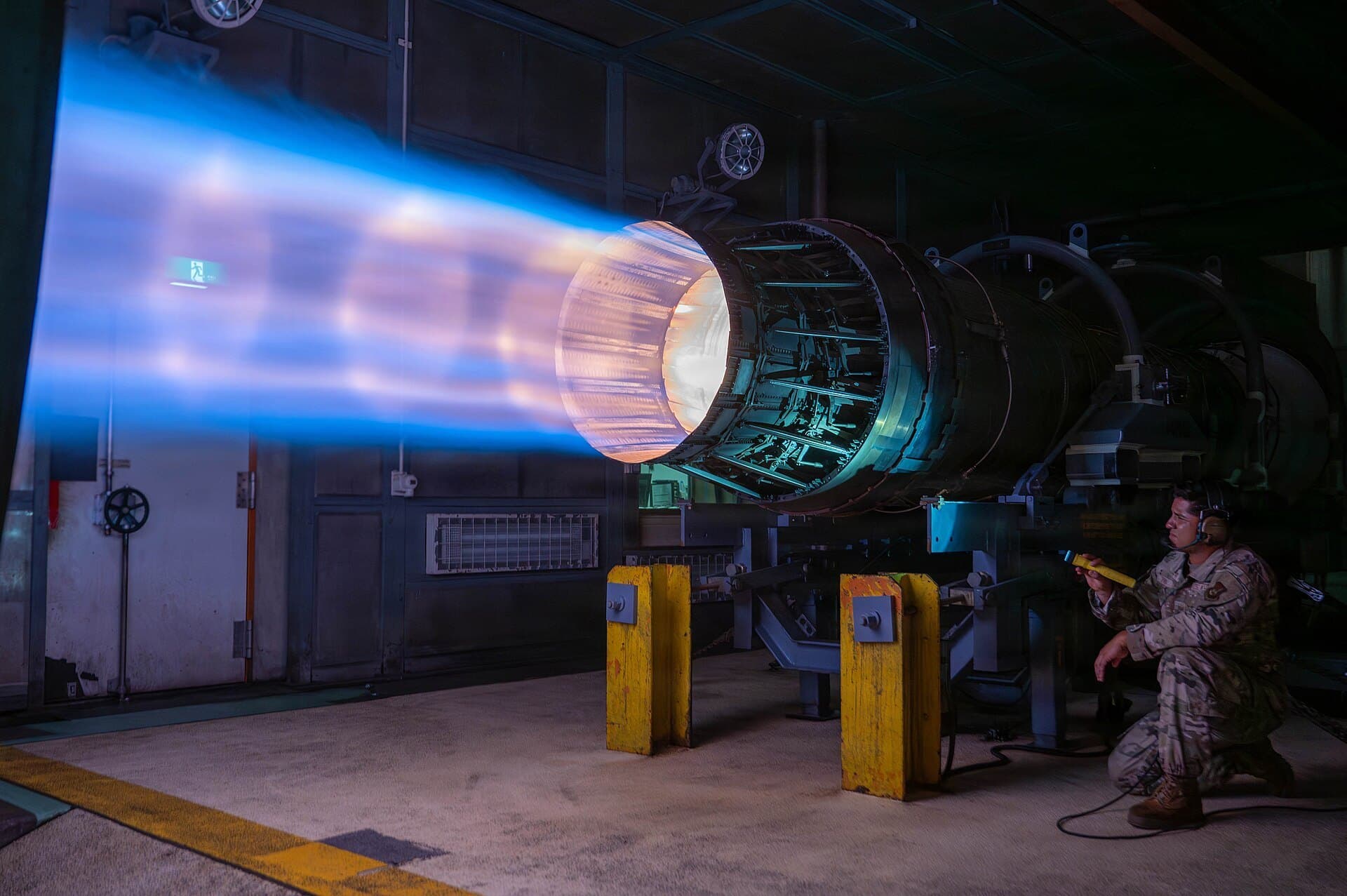
The US Air Force says the November 20 announcement naming 58 companies to a $16.1 billion propulsion contract was published in error and no contracts were awarded. The service still plans to award the APAC vehicle later.
By Michael Korten ·
Update, November 24: The Air Force has withdrawn this award. A service spokesperson told Breaking Defense on November 23 that the November 20 announcement was posted in error, and the Department of War added a correction to its contract list for November 23: the $16.1 billion contract "was erroneously published. The contracts were not awarded." The Air Force says it still plans to award APAC and that 58 vendors are so far planned for selection. The article below has been revised to reflect this.
The US Air Force has walked back one of its biggest engine contracts before it began. On November 20, the Department of War's daily contract list named 58 companies to a propulsion contract with a combined ceiling of $16.1 billion running through November 2041. Three days later the department said the notice was published in error and that no contracts had been awarded.
- 58 companies were listed, from GE, RTX, Rolls-Royce and Honeywell to start-ups such as Hermeus and Beehive
- The Department of War now says the award was published in error and not made
- The Air Force still plans to award APAC; 58 vendors are "so far planned for selection"
- $16.1 billion is a shared ceiling; firms would compete for individual task orders
How the contract works
The $16.1 billion figure is a ceiling, not money to be spent. Under the plan, each company would receive a token $1,000 to attend a post-award orientation, and the winners would then compete for task orders. The contract covers "advanced propulsion enterprise work" across every stage of engine development and is run by Air Force Materiel Command at Wright-Patterson Air Force Base, Ohio. "Future orders will be competed among the qualified vendor pool as requirements are validated and funded," the Air Force said in its November 23 statement.
It matches the Advanced Propulsion Acquisition Contract (APAC) that the Air Force Life Cycle Management Center's Propulsion Directorate outlined in March. That notice described a vehicle to "rapidly develop technology for novel propulsion technologies" and named Collaborative Combat Aircraft Increment 2 and the F-47 fighter as possible future platforms. It also said the effort had no dedicated funding yet.
Who is on the list
The withdrawn list included all the established names: GE, RTX, Rolls-Royce North American Technologies, Honeywell and Williams International, which builds small turbofans for cruise missiles. So did aircraft makers Boeing, Lockheed Martin and Northrop Grumman, plus Aerojet Rocketdyne, Safran Defense & Space and services firms such as Booz Allen Hamilton and Amentum.
Many of the listed companies are newer companies working on drone, missile and high-speed engines. They include Hermeus of Atlanta, whose Quarterhorse aircraft flies on a turbine-based combined-cycle engine built around a GE J85 core, Astro Mechanica, Velontra and Whisper Aero. Beehive Industries, which 3D-prints small jet engines and won a CCA Increment 2 engine contract in February, is on the list, as are JetCat Defense, Sintavia, Mach Industries and Southwest Research Institute. The only company based outside the United States is Bet Shemesh Engines of Israel. Ohio and Alabama account for the largest groups on the list.
Why it matters
Cheap, mass-produced engines are now a bottleneck for drones, loyal wingmen such as the CCA and long-range missiles. Once APAC is awarded, putting start-ups on the same contract as the big engine makers would let the Air Force move a promising design toward production without a new competition each time. It sits alongside the Next Generation Adaptive Propulsion programme, under which Pratt & Whitney and GE Aerospace received a combined $7 billion in 2025 to mature adaptive engines for future fighters. For the CCA context, see our comparison of Kizilelma and the YFQ-44A Fury.