Air4 min read
Kizilelma vs YFQ-44A Fury: Two Very Different Answers to the Unmanned Fighter Question
Turkey's Kizilelma and America's YFQ-44A Fury both fly fighter missions without a pilot, and both reached service or production in 2026. One is a heavy, near-fighter-sized jet built to fight on its own; the other is a small, cheaper wingman built to fly beside crewed fighters.
By Michael Korten ·
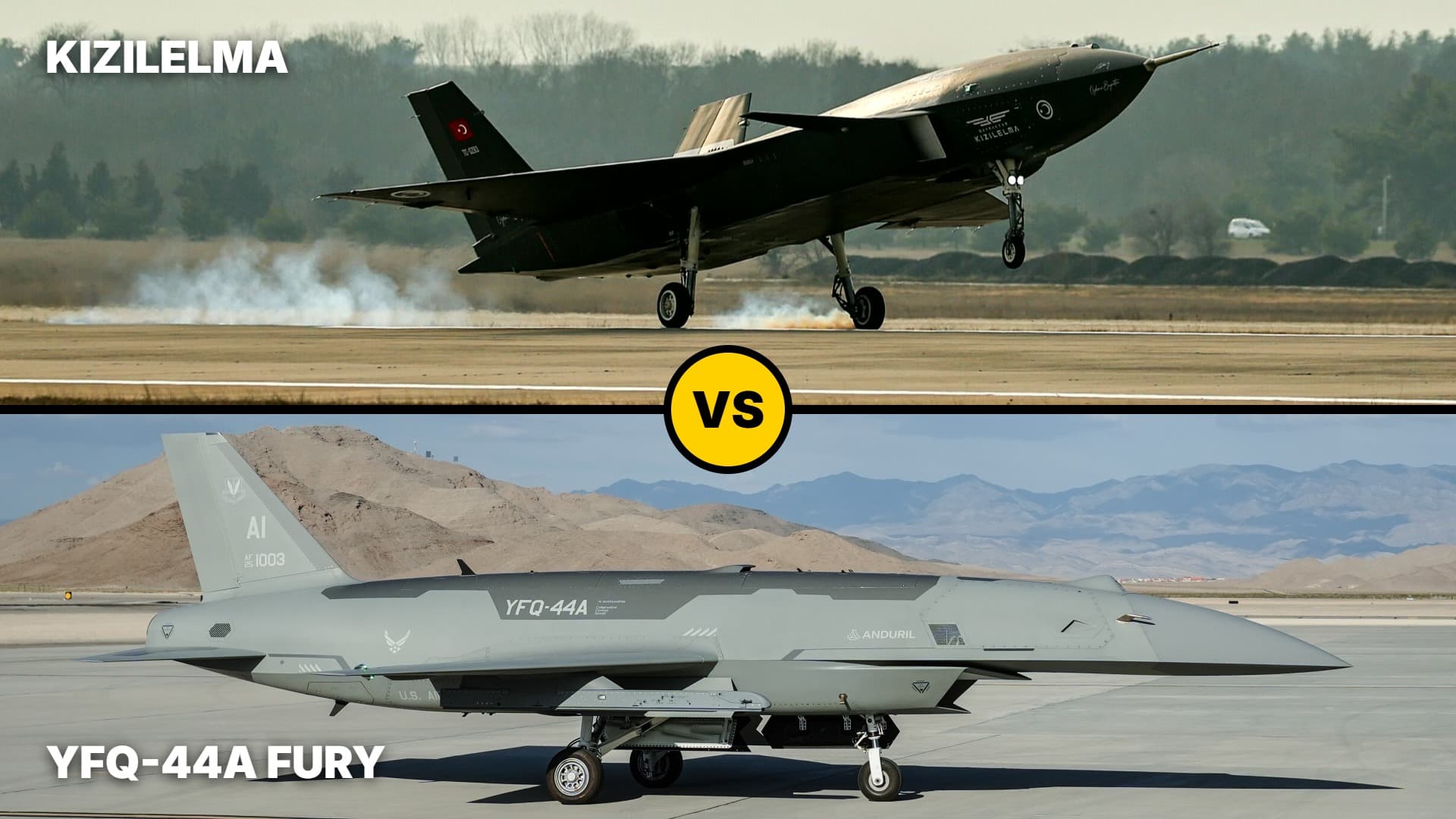
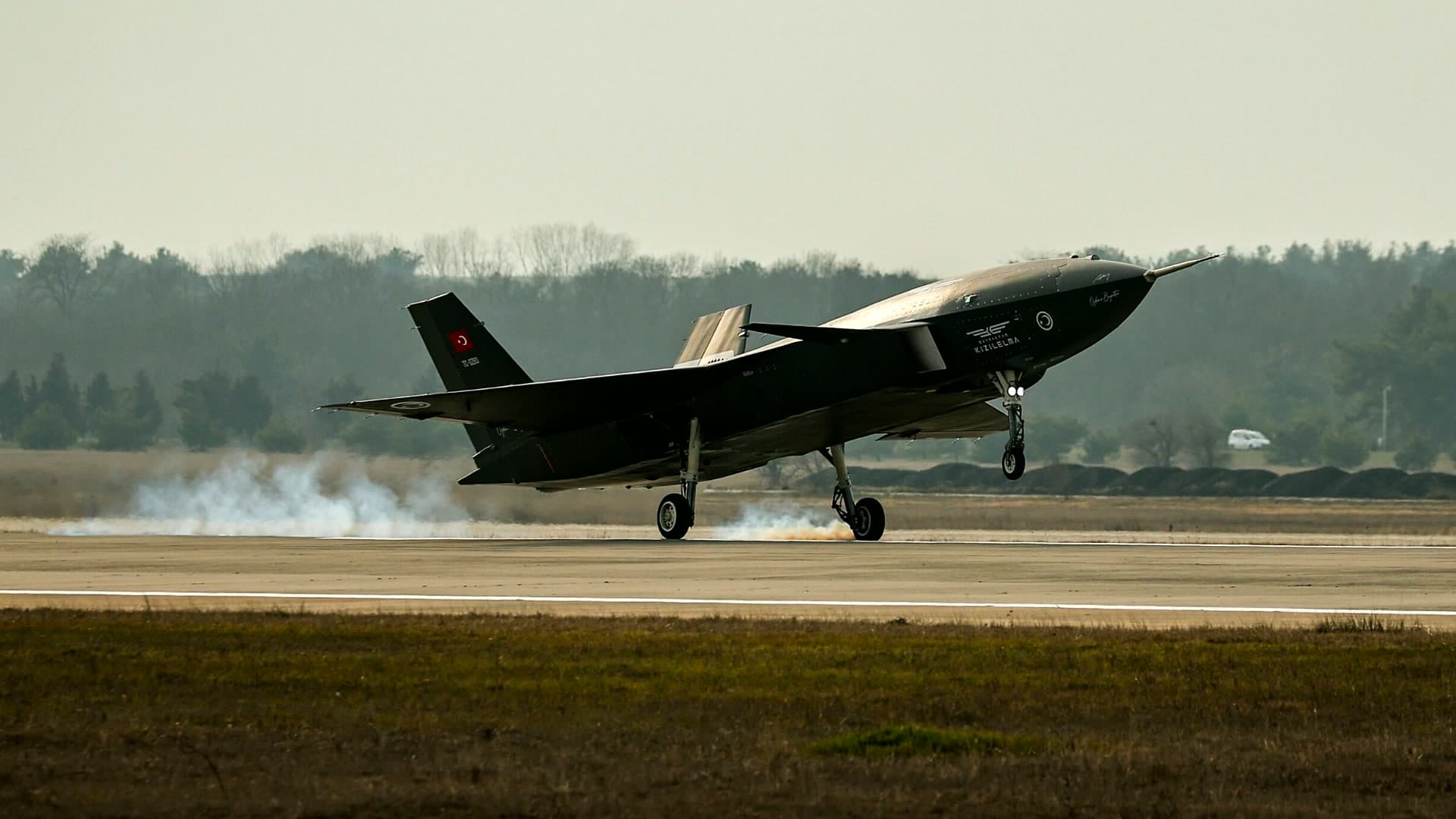
Two unmanned combat jets reached a milestone within months of each other in 2026. Baykar delivered the first three Kizilelma to Turkish forces this week, making Turkey the first country to field a jet-powered unmanned fighter. In the United States, Anduril's YFQ-44A Fury was picked for production in June and the first aircraft built at its new Ohio plant rolled out in July.
They are often mentioned in the same sentence. They should not be confused. The two aircraft answer the same question, how to fight in the air without a pilot on board, in almost opposite ways.
Size tells the story
The quickest way to see the difference is the scales. Baykar gives the Kizilelma a maximum take-off weight of 8,500 kg and a payload of 1,500 kg. It is 14.5 m long with a 10 m wingspan, close to the footprint of a light fighter. Open-source figures put the Fury at roughly 2,270 kg, 6.1 m long and 5.2 m across, about a quarter of the Turkish jet's weight.

Kizilelma and YFQ-44A side by side. Figures marked ~ are open-source estimates; Anduril has not published full specifications. Militrax graphic.
Speed is a wash. Baykar quotes Mach 0.9 at top speed and Mach 0.6 in cruise, with a combat radius of 500 nautical miles. The Fury is credited with about Mach 0.95. Neither is supersonic, and neither is meant to be: both trade raw performance for cost, endurance and numbers.
Two design philosophies
Kizilelma is built to be a fighter in its own right. It has an internal weapons bay, a shaped, low-observable airframe and enough payload to carry Turkish air-to-air missiles, precision bombs or cruise missiles. Baykar has already used it to shoot down a jet-powered target with a beyond-visual-range missile, and it wants the aircraft to work from short runways and, eventually, from the deck of TCG Anadolu. Turkey sees it as part of a mixed fleet with the crewed KAAN, but also as a strike and air-combat platform that can go out alone.

A rendering of Kizilelma from below, showing the internal weapons bay doors and canards. Baykar image.
The Fury comes from a different brief. The US Air Force's Collaborative Combat Aircraft programme wanted a wingman, not a replacement for a pilot: a cheaper aircraft that flies ahead of or beside an F-35 or F-47, carries extra missiles and sensors, and can be lost without losing a person. The YFQ-44A carries weapons on two underwing stations, with four planned on the production FQ-44, and the Air Force has shown it with inert AIM-120 AMRAAMs. It was built around a commercial business-jet engine to keep cost and maintenance down.

Airmen prepare inert AIM-120 missiles for loading onto a YFQ-44A Fury at Creech Air Force Base, July 2026. File photo.
Autonomy and control
Here the gap is less about hardware and more about doctrine. The Air Force has separated the aircraft from the brain: CCA airframes run government-owned autonomy software, and in this year's trials CCA prototypes have flown in formation and practised air-combat tactics with autonomy software such as Shield AI's Hivemind. The plan is for a pilot in a crewed fighter to command several of them at once.
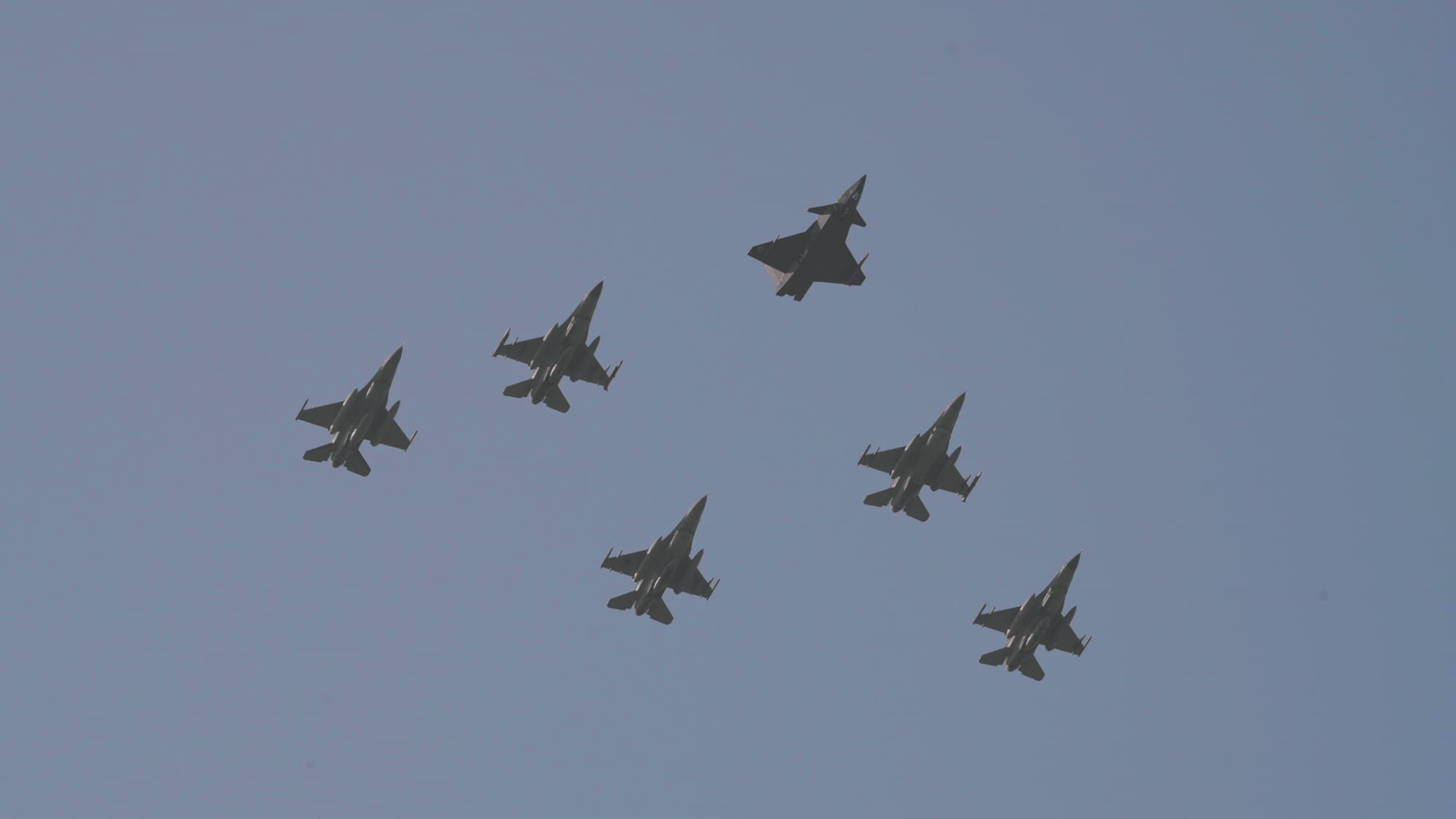
Baykar has developed its own flight-control and autonomy software in-house, as it did for the TB2 and Akinci, and has shown Kizilelma flying in close formation with F-16s. It can be flown from a ground station or teamed with crewed aircraft. The Turkish approach keeps more decisions with the aircraft and its ground crew; the American approach ties the drone tightly to the fighter it escorts.
Cost and numbers
Neither company has published a unit price. The Air Force has said its CCAs should cost a fraction of an F-35, and it plans to buy them in large numbers; Anduril built a dedicated factory, Arsenal-1, to make them. Kizilelma is a bigger, more capable aircraft and will almost certainly cost more per airframe than the Fury, but it is also expected to do more on its own. Turkey has not said how many it will buy. Indonesia has signed for 12 with an option on 48 more.
What each one is good at
Kizilelma's strengths are payload, range and independence. It can carry a heavier load internally, fly long strike missions and act as a stand-alone combat aircraft for an air force that does not have hundreds of fighters to escort. Its question marks are maturity and engines: it has only just entered service, and the long-term powerplant depends on Turkey's TF6000 programme.
The Fury's strengths are cost, production rate and integration. It is designed to be built quickly and in numbers, to plug into the US network of fighters, tankers and sensors, and to be expendable when it has to be. Its question marks are payload and reach: a 2.3-tonne aircraft cannot carry much, and its value depends on the crewed fighters it flies with.
Why it matters
These are not rivals for the same contract. They are two bets on what air combat will look like in the 2030s. The US is betting on swarms of cheaper wingmen orbiting a few expensive crewed fighters. Turkey is betting on a smaller number of capable unmanned fighters that can fight with or without a pilot nearby. Most air forces will end up with something in between, and both of these aircraft will be the yardsticks they measure against.