5 min read
United States Nuclear Testing: What Resuming a Nevada Blast Would Take, a Year After Trump's Order
A year after President Trump ordered nuclear testing "on an equal basis", the United States has run subcritical, detection and missile tests but no nuclear explosion since 1992. A real test in Nevada would need up to 36 months of visible preparation and would hand Russia and China cover to test too.
By Michael Korten ·
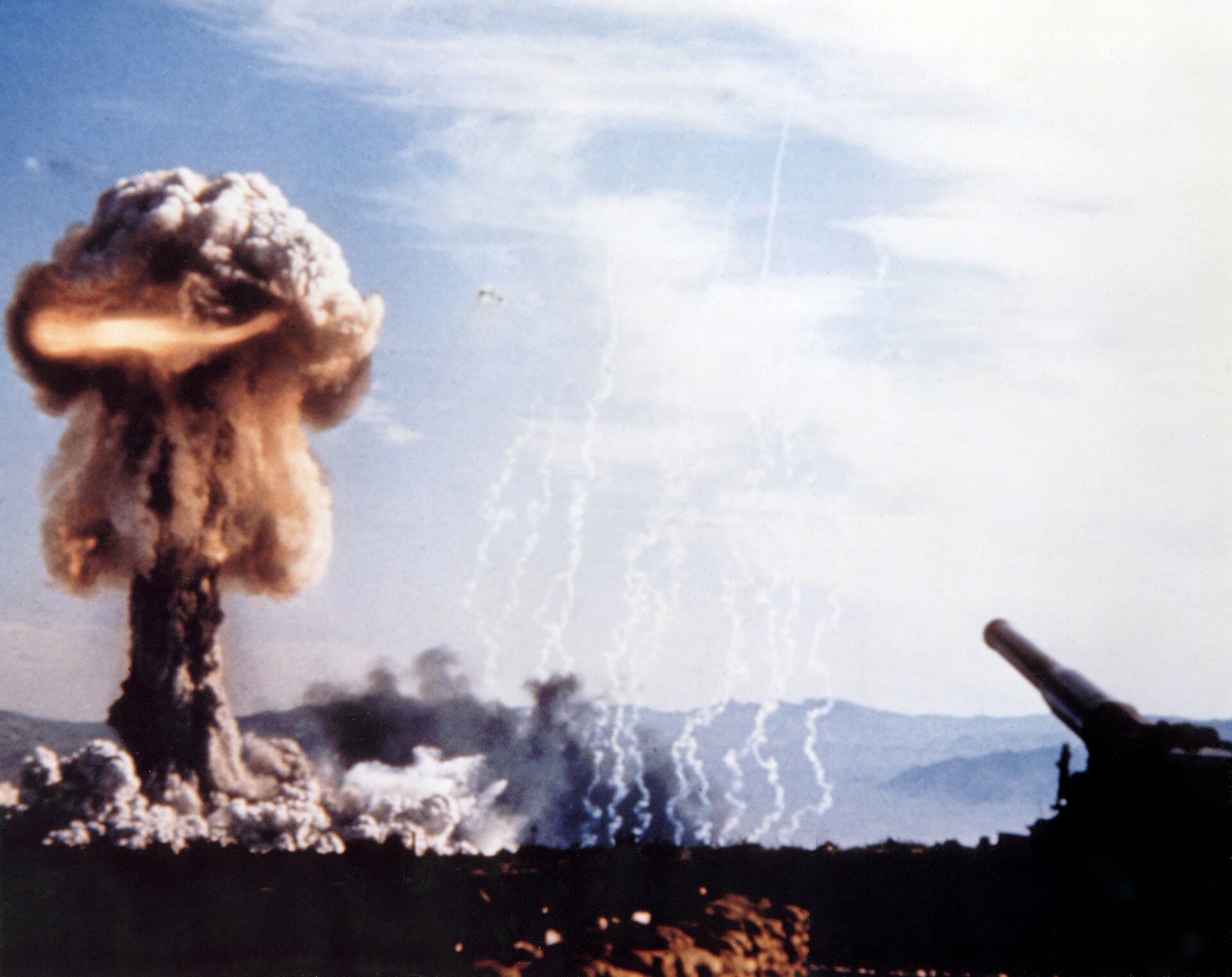
The last time the United States set off a nuclear explosion was on 23 September 1992, when a device code-named Divider was detonated in a shaft beneath the Nevada desert. Thirty-four years later, a presidential order to resume testing is more than a year old and the Nevada National Security Site is busy again, yet no American nuclear device has produced a single kiloton of yield.
That gap between the political order and the physical reality is the story. Closing it would take a deliberate strategic decision, a long and visible preparation in Nevada, and a willingness to accept what Russia and China would do next.
What was actually ordered
On 30 October 2025, shortly before meeting China's Xi Jinping, President Donald Trump wrote on Truth Social that he had instructed the Pentagon to start testing US nuclear weapons "on an equal basis" with other countries. The post did not say what kind of test he meant, and it was read around the world as an order to resume explosive testing.
Within days, Energy Secretary Chris Wright, whose department owns the warheads through the National Nuclear Security Administration (NNSA), narrowed it. Speaking on Fox News, he described the planned activity as system tests and non-critical explosions of the non-nuclear parts of a weapon, not nuclear detonations. That clarification still stands. No US official has since announced a date, a site or a device for a yield-producing test.
Three things that are all called "testing"
Much of the confusion comes from one word covering three very different activities.
Explosive nuclear test. A warhead is detonated and produces nuclear yield. The United States conducted 1,030 of these between 1945 and 1992 by the Congressional Research Service count; the Energy Department's list reaches 1,054 because it adds 24 joint tests with Britain. None has taken place since 1992.
Subcritical experiment. High explosives drive plutonium, but the assembly never reaches a self-sustaining chain reaction, so there is no nuclear yield. These take place deep underground in the U1a complex in Nevada and are consistent with the Comprehensive Nuclear-Test-Ban Treaty (CTBT) as Washington reads it.
System or flight test. Delivery vehicles such as the Minuteman III ICBM are launched unarmed from Vandenberg Space Force Base to check reliability and accuracy, and warhead components are checked without their nuclear material. This is routine and has never stopped.
When administration officials say the United States is testing, they mean the second and third categories. When allies and adversaries hear the word, they hear the first.

An unarmed Minuteman III ICBM streaks into the night sky during an operational test launch from Vandenberg Space Force Base, California, on 21 May 2025. Flight tests like this continue as routine. File photo.
What a real explosion would require
The Congressional Research Service says the United States maintains the ability to resume explosive testing within 24 to 36 months of a presidential decision. That figure is for a fully instrumented test that would actually teach the laboratories something. A cruder detonation designed mainly as a political signal could be done faster, but it would yield little technical data.
The work is physical and hard to hide. A vertical shaft hundreds of metres deep has to be drilled or reopened, a canister of diagnostics built and lowered with the device, cables run to recording stations, and containment designed so that radioactive gas does not vent. Much of the workforce that did this before 1992 has retired. Nevada's congressional delegation is on record against any explosive test, and Senators Catherine Cortez Masto and Jacky Rosen, with colleagues from Arizona and New Mexico, introduced the No Nuclear Testing Without Approval Act on 5 November 2025, which would require congressional approval first.
The most recent activity at the site points in a different direction. On 30 September 2026 the NNSA announced a chemical high-explosive shot in P Tunnel, Area 12, laced with radiotracers and ringed by seismic, infrasound and electromagnetic sensors. Its stated purpose was to improve detection of "decoupled" explosions, in which a device is fired inside a large underground cavity to muffle its seismic signature. US officials have alleged that China carried out such a test at Lop Nur in June 2020; Beijing called the claim unfounded.
The case for testing
Supporters of resumption make three arguments. First, the arsenal is changing: the B61-13 gravity bomb is in production and the W93 submarine warhead is in development, and some argue that new designs should not enter service without a full-scale test. Second, effects testing: modern electronics in satellites, missiles and command systems have never been exposed to a real nuclear environment. Third, signalling: if Russia or China are conducting very low-yield tests, as US officials allege, matching them would show resolve.
The case against
Most specialists, including many former weapon designers, argue the opposite. The laboratory directors have certified the stockpile as safe and reliable in an annual assessment every year since the mid-1990s without a test, using supercomputer modelling, subcritical experiments and facilities such as the National Ignition Facility. The United States also holds by far the largest library of test data in the world. A US test would give Russia and China political cover to test as well, and China, with roughly 45 tests against America's 1,030, has much more to learn from new data than Washington does.
There is a treaty cost too. The United States signed the CTBT in 1996, but the Senate rejected ratification in 1999, so it is not legally bound. It has nevertheless observed a moratorium since October 1992 and helps fund the treaty's International Monitoring System, a network of more than 300 stations built to detect a test within hours.
What Russia, China and North Korea are doing
Russia withdrew its ratification of the CTBT in November 2023, saying it wanted to mirror the US position, and has kept its Novaya Zemlya test site in the Arctic active. After the US order, Vladimir Putin told his Security Council in November 2025 to prepare proposals for a possible test, while saying Moscow would act only if Washington did. China has expanded tunnelling and facilities at Lop Nur, according to US government reports, without a declared test since 1996. North Korea's sixth and last test, on 3 September 2017 at Punggye-ri, remains the most recent declared nuclear explosion anywhere.
What to watch
The signs that a real test is coming would be visible well in advance: NNSA budget lines for test readiness, contracts for drilling and diagnostics in Nevada, congressional language either funding or blocking a test, and any change in how Energy Department officials describe the programme.
Why it matters
For now, the likeliest outcome is more subcritical experiments, more detection research and more missile flight tests, presented politically as "testing". A yield-producing explosion would be a separate decision, with a runway of up to three years and consequences that reach far beyond Nevada. The first US nuclear test in more than three decades would almost certainly not be the last test anyone conducts.