Land5 min read
Türkiye's S-400 Question Explained: How Russia's S-400 and America's Patriot Really Compare
Türkiye's S-400s, bought for $2.5 billion and the reason it lost the F-35, are again under discussion with Moscow. We compare the S-400 Triumf and Patriot on radars, missiles, real ranges, combat record, buyers and cost, without picking a winner.
By Michael Korten ·
When Türkiye took delivery of its first Russian S-400 batteries in July 2019, it paid for them twice: roughly $2.5 billion under the 2017 contract, and its place in the F-35 programme, from which Washington removed it that same month. US sanctions under CAATSA followed in December 2020. Seven years later the systems are still the main obstacle between Ankara and the F-35, and the Kremlin has now confirmed that their future is under discussion, which keeps the oldest question in air defence alive: how does the S-400 Triumf actually compare with America's Patriot?
The short answer is that they were built to answer different questions. The S-400 is a long-range area-defence system designed to push enemy aircraft, and the aircraft that support them, as far from Russian territory as possible. Patriot, in its current form, is above all a point defence against ballistic missiles that has grown back into a broader air-defence role. Comparing their headline ranges, the way most online rankings do, misses most of what matters.
Two architectures, two philosophies
An S-400 battalion is built around a family of radars and several missile types. The 91N6E long-range acquisition radar watches the airspace, the 92N6E multifunction radar guides missiles in flight, and truck-mounted launchers carry four large canisters each. Russian units can add the 96L6 all-altitude detector and link several battalions to a regional command post. Testing began in late 1999 at Kapustin Yar, according to the CSIS Missile Defense Project, and the system entered Russian service in 2007.
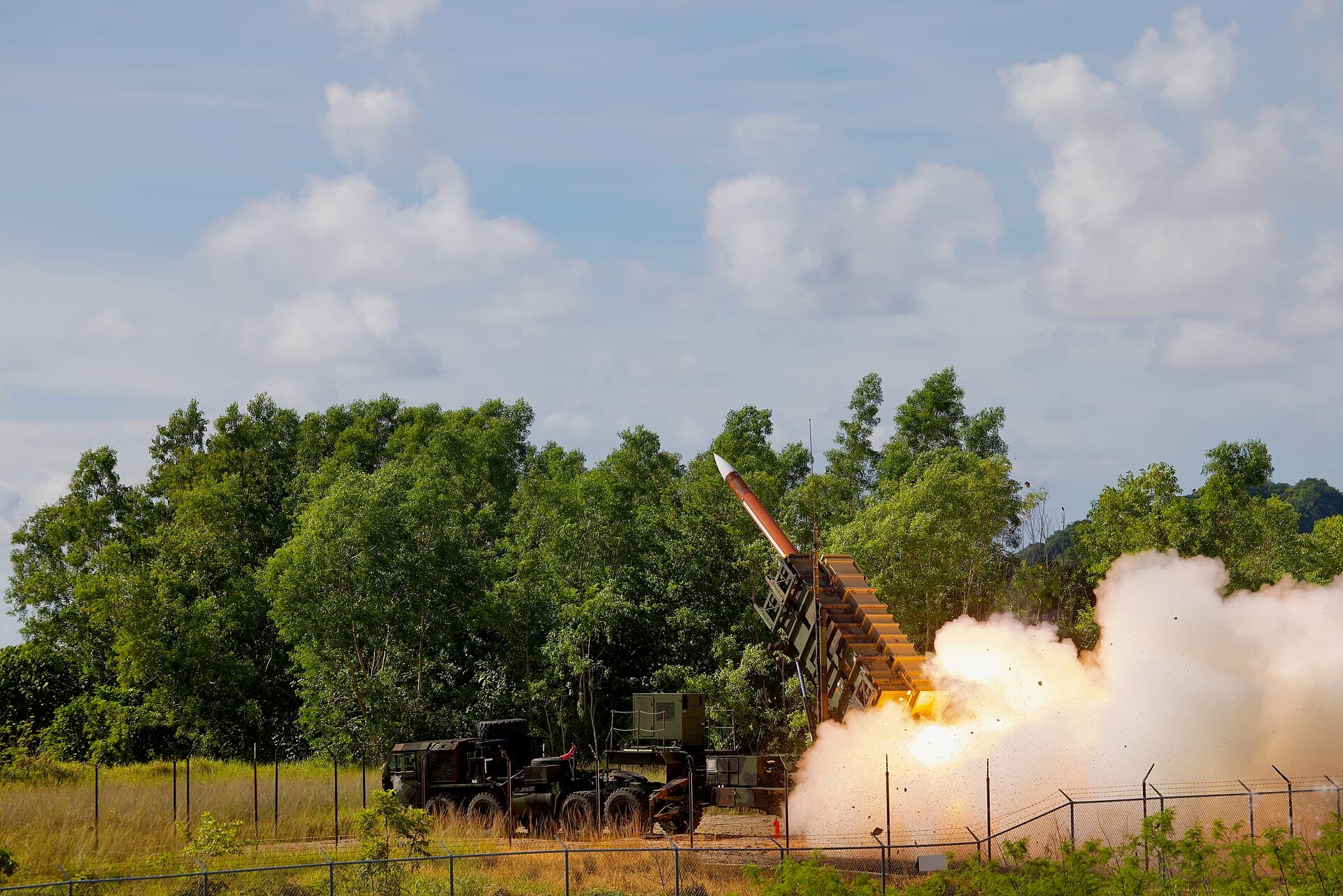
A Patriot battery centres on a single radar. The AN/MPQ-65 looks across a sector rather than a full circle, which is why batteries are positioned with care and why the US Army is replacing it with the 360-degree LTAMDS radar. Since a 1993 upgrade, Patriot launchers can stand up to about 10 kilometres from the radar, CSIS notes, letting a battery cover a wider footprint. An M903 launcher carries four of the larger PAC-2 GEM-T rounds or a bigger load of the slimmer PAC-3 hit-to-kill interceptors, and many batteries now mix both.

An S-400 launcher raises its missile canisters at the Ashuluk training ground in southern Russia. Photo: Ministry of Defence of the Russian Federation (mil.ru), CC BY 4.0. File photo.
Missiles and range: what the numbers really mean
The S-400's best-known figure is 400 kilometres, the published maximum for the 40N6 missile. The 48N6 family is credited with up to 250 km and carries a 143 kg blast-fragmentation warhead, according to CSIS, while the smaller 9M96 missiles cover shorter ranges with greater agility. The 400 km figure applies to a large, high-flying target such as a tanker, an airborne early-warning aircraft or a transport. Against a low-flying fighter or cruise missile the radar horizon, not the missile, sets the limit, and against ballistic missiles CSIS puts the S-400's defended radius at only around 60 km.
Patriot's ranges are not officially published. Open-source estimates for the GEM-T against aircraft cluster around 160 km. The PAC-3 MSE, now the system's main missile, trades reach for precision. It destroys a target by hitting it directly rather than exploding nearby, and its enlarged two-pulse motor "nearly doubles" the range of the original PAC-3, CSIS says. Against a ballistic missile that is the number that counts, and it is an area where Patriot has far more test and combat data than the S-400.
Combat record: claims and confirmations
Patriot has the longer and better-documented record. The PAC-3 was first used in combat in 2003 during the invasion of Iraq. In May 2023, Ukraine said a Patriot battery near Kyiv had shot down a Russian Kh-47M2 Kinzhal air-launched ballistic missile, and the Pentagon confirmed the intercept. Since then Patriot has become the backbone of Kyiv's defence against Russian ballistic missiles, and Ukraine's demand for more batteries and interceptors has driven much of the West's air-defence diplomacy.
The S-400's record is mostly Indian and mostly claimed. During Operation Sindoor, the four-day India–Pakistan conflict of May 2025, India's air force credited its S-400s, which it calls Sudarshan Chakra, with several kills. In August 2025, Air Chief Marshal A.P. Singh said one engagement destroyed a large Pakistani aircraft at around 300 km, which would be among the longest surface-to-air kills on record. Pakistan denies losing such an aircraft, and no independent evidence has been published. In Crimea, Ukraine's military intelligence and defence ministry have repeatedly said they destroyed S-400 radars and launchers with drones and missiles in 2023 and 2024, which shows that a long-range system still needs a layered short-range defence around it.
Who buys them, and what it costs
Raytheon lists 19 countries that operate Patriot, from Germany, Poland and the Netherlands to Japan, Saudi Arabia, the UAE and Ukraine. The S-400 club is smaller: Russia, China, India, Türkiye and Belarus. The politics weigh as much as the hardware. Any S-400 buyer risks US sanctions under CAATSA, as Türkiye found, while Patriot buyers depend on US export approval and on a production line that has struggled to keep up with demand.
Contract values give a sense of scale. Türkiye's purchase was about $2.5 billion. India ordered five S-400 squadrons in 2018 for about $5.43 billion. Three are in service, and Russian officials have said the remaining two would arrive by 2026–27. Patriot costs are harder to compare because buyers often purchase batteries, radars and interceptors separately. The interceptor supply is the real constraint. Lockheed Martin delivered more than 600 PAC-3 MSE missiles in 2025 and, under a seven-year framework signed with the Pentagon in January 2026, aims to raise output to around 2,000 a year by the end of the decade.
Türkiye's batteries and what comes next
Kremlin spokesman Dmitry Peskov confirmed in July 2026 that Moscow and Ankara were discussing the S-400s, calling it an extremely sensitive issue, and said on 30 September that moving them to a third country friendly to Russia was on the agenda. No deal has been announced. Militrax reported earlier on the Gulf transfer options that have been floated.
Both systems are also about to change. Russia is fielding the S-500 for higher-altitude ballistic missile defence. The US Army is pairing Patriot with LTAMDS and the IBCS battle-management network, which lets any sensor cue any launcher. South Korea fielded the first certified IBCS-linked Patriot battery this month.
The verdict a specialist would give
Neither system is simply "better." The S-400 offers more reach against large aircraft and a deep missile family in a single battalion. That is why India values it against a two-front threat and why NATO air forces plan around its range rings. Patriot offers proven hit-to-kill performance against ballistic missiles, a large allied user base and growing integration with Western sensors, and it has been tested in daily combat in Ukraine. Which one a country needs depends on the threat it faces and on which camp it is willing to depend on. For Türkiye that second question has cost more than the systems themselves. For a closer look at Patriot against its European rival, see our Patriot vs SAMP/T NG comparison.