Land4 min read
Poland's K2 vs Germany's Leopard 2A8: How Europe's Two New-Build Tanks Compare
Europe is buying new tanks again, and two designs are taking almost all of the orders: South Korea's K2 Black Panther, chosen by Poland, and KNDS's Leopard 2A8, ordered by at least six European countries. A neutral look at crew, protection, firepower, orders, industry and delivery speed.
By Michael Korten ·
For three decades, European armies mostly upgraded old tanks. Now they are buying new ones, and two designs are taking almost every order. Poland has signed for 360 South Korean K2 Black Panthers, with a framework for up to 1,000. KNDS says the Leopard 2A8, the newest version of Germany's best-known tank, has passed about 350 orders across Europe.
The two tanks answer the same question in different ways. The K2 is a three-crew design with an autoloader and an adjustable suspension, built by Hyundai Rotem and delivered at a pace no European line has matched. The Leopard 2A8 is the latest step in a family that already serves in more than a dozen armies, with a four-person crew and an active protection system fitted as standard.
This comparison does not pick a winner. Both tanks are modern, both fire NATO-standard 120 mm ammunition, and each buyer weighed delivery time, industry and fleet commonality as heavily as armour and firepower. Militrax compared the Abrams and the Leopard 2 earlier this month; this piece looks at the two tanks Europe is actually ordering new.
Design: three crew or four
The biggest design difference is inside the turret. The K2 loads its 120 mm, 55-calibre gun automatically, so it needs only a commander, gunner and driver. Supporters say this saves weight and armour volume and frees soldiers for other units. The Leopard 2A8 keeps a human loader and a four-person crew, which KNDS and its users argue spreads the work of maintenance, guard duty and repairs in the field.
The second difference is the running gear. The K2 rides on hydropneumatic suspension that can raise, lower and tilt the hull, letting the tank aim lower from behind cover or ride higher over rough ground. The Leopard 2A8 keeps the family's torsion-bar suspension, a simpler and well-understood layout shared with thousands of Leopard 2s already in service.
Both tanks use 1,500-horsepower diesel power packs, the Leopard 2A8 with an MTU engine. Power-pack sourcing has been a sensitive point in the K2 programme, and Korea has worked for years on a fully domestic engine and transmission.

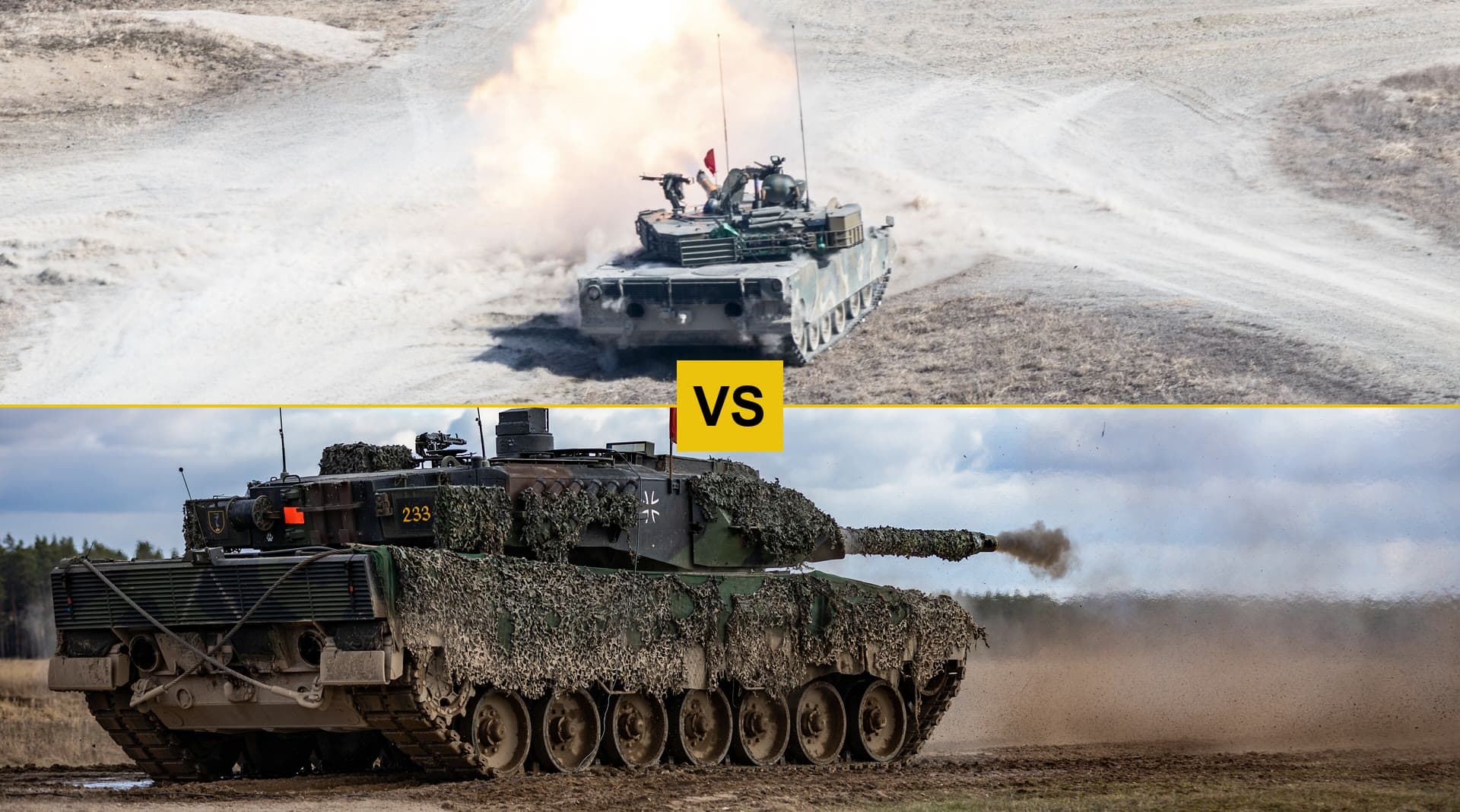
A Polish Army K2 manoeuvres on the range at Bemowo Piskie, Poland, during a live-fire demonstration in March 2023. File photo.
Key figures
- Crew: K2, 3 with an autoloader; Leopard 2A8, 4 with a manual loader
- Main gun: both 120 mm, 55 calibres long (the Leopard 2A8 uses Rheinmetall's L/55A1)
- Engine: both about 1,500 hp diesel
- Suspension: K2, adjustable hydropneumatic; Leopard 2A8, torsion bar
- Active protection: Leopard 2A8, Trophy as standard; K2 for Poland, planned on the Polish-built K2PL, with the system not yet publicly confirmed
- Combat weight: K2 about 55 tonnes; KNDS has not published a firm figure for the 2A8
Protection in the drone era
The war in Ukraine has made top-attack drones and loitering munitions the threat every new tank is judged against. KNDS answered it by making the Israeli-designed Trophy hard-kill system standard on the Leopard 2A8. Trophy detects incoming rockets and missiles and fires a charge to destroy them before impact, and it has been combat-proven on Israeli Merkava tanks.
Poland's later K2PL version is meant to add heavier armour and an active protection system, assembled in Poland. Until that system is selected and fielded, the K2s Poland is receiving now rely on their composite armour, smoke and soft-kill protection. Leopard 2s in Ukraine have shown how much a crew-protective design matters: one Ukrainian Leopard 2 survived 45 FPV drone strikes, according to its commander.
Orders and deliveries
Poland is the K2's only European customer so far, but it is a large one. Warsaw signed a framework for up to 1,000 K2s in July 2022 and a first contract for 180 tanks a month later, with the first deliveries arriving in December 2022, only months after signing. A second contract, signed on 1 August 2025 and worth about $6.5 billion, covers another 180 tanks plus 81 support vehicles: 116 K2GF tanks for 2026 and 2027, and 64 K2PL tanks for 2028 to 2030. The first tanks under that second contract arrived in August 2026.
The Leopard 2A8's order book is spread across Europe:
- Germany: 123 ordered, with 75 more planned
- Norway: 54, most of them built in Norway
- Czech Republic: 44, plus options for 14 more
- Netherlands: 46
- Lithuania: 44
- Sweden: 44 new tanks, known locally as the Strv 123B, plus 66 upgraded older Leopards
Most Leopard 2A8 buyers will not receive their tanks until 2027 or later, which is the main trade-off against the K2's delivery pace.

A German Army Leopard 2A6 drives onto the range at Bemowo Piskie, Poland, in April 2023. The Leopard 2A8 is a new-build development of this family. File photo.
Industry and price
Both deals are as much about factories as tanks. Under the second Polish contract, 61 of the 64 K2PL tanks will be assembled at Bumar-Łabędy in Gliwice, the start of a Polish production line. Norway will build most of its Leopard 2A8s at home, and Lithuania is getting a KNDS assembly site in Kaunas.
Contract prices are hard to compare directly, because they bundle support vehicles, training, spare parts and upgrades in different ways. Poland's $6.5 billion covers 180 tanks and 81 engineering, recovery and bridging vehicles. Sweden's contract with KNDS, signed in January 2025 and worth about $1.97 billion, covers 44 new tanks and the upgrade of 66 older ones. A simple price per tank would mislead.
What each buyer is choosing
Poland chose speed and a share of production. It needed tanks quickly after giving older tanks to Ukraine, and Hyundai Rotem delivered within months while promising a Polish production line. Poland also operates American Abrams and older Leopard 2s, so it accepts running three tank fleets.
The Leopard 2A8 buyers chose commonality. Most already operate Leopard 2s, and a shared European fleet means shared training, spare parts, ammunition and repair work across borders. The price is a longer wait.
Neither tank has yet fought a war. The answer to which design is better will depend less on brochure figures than on how fast each line delivers, how well the protection works against drones, and how many tanks each army can keep running.