Air3 min read
Canada: 'We Don't Report to the United States,' Minister Says After Pentagon Attacks Its Readiness
A Pentagon fact sheet says only 41.9% of Canada's air force fleet was serviceable last year and accuses Ottawa of having no credible plan to reach NATO's 5% target. Defence Minister David McGuinty replied that Canada is on track to 4% of GDP by 2030 and does not report to Washington.
By Michael Korten ·
Canada's defence minister has pushed back against an unusually blunt Pentagon broadside on Canadian military readiness, telling reporters in Ottawa on Tuesday that "Canada is a sovereign nation. I'll be very direct. We don't report to the United States."
David McGuinty was responding to a two-page "fact sheet" the US Department of Defense released on Monday, 23 November, after Axios first reported it a day earlier. The document accuses Ottawa of failing to make the hard choices needed to modernise its armed forces and meet NATO commitments. "Canada's defense shortfalls speak for themselves," it says. "Canada must get serious and focused."
What the Pentagon says
The fact sheet leans on readiness numbers. It says only 41.9% of the Royal Canadian Air Force fleet was serviceable in 2025-26, "largely due to ageing equipment and personnel shortages", and that just 53.9% of the naval fleet was serviceable over the same period. It puts the Canadian Army's operational readiness at 48%. Canada's own Department of National Defence has reported the same equipment shortages, but found that 61% of its military units were ready for operations, according to Axios.
On money, the Pentagon says Canada has no credible, fully costed plan to reach NATO's new target of 5% of GDP by 2035, and accuses Ottawa of pushing its biggest increases past the 2029 federal election. It also attacks the review of Canada's planned purchase of 88 F-35A fighters, warning that a mixed fleet could deepen personnel shortages, and charges Canadian leaders with putting domestic economic interests ahead of military effectiveness, to the detriment of NORAD.
The paper follows a classified directive from Defense Secretary Pete Hegseth last week that, according to Republican Senator Mike Rounds, largely restricts US military officials from taking part in Canadian think-tank and social events. Rounds said at the Halifax International Security Forum that it was not expected to affect joint operations or intelligence sharing.

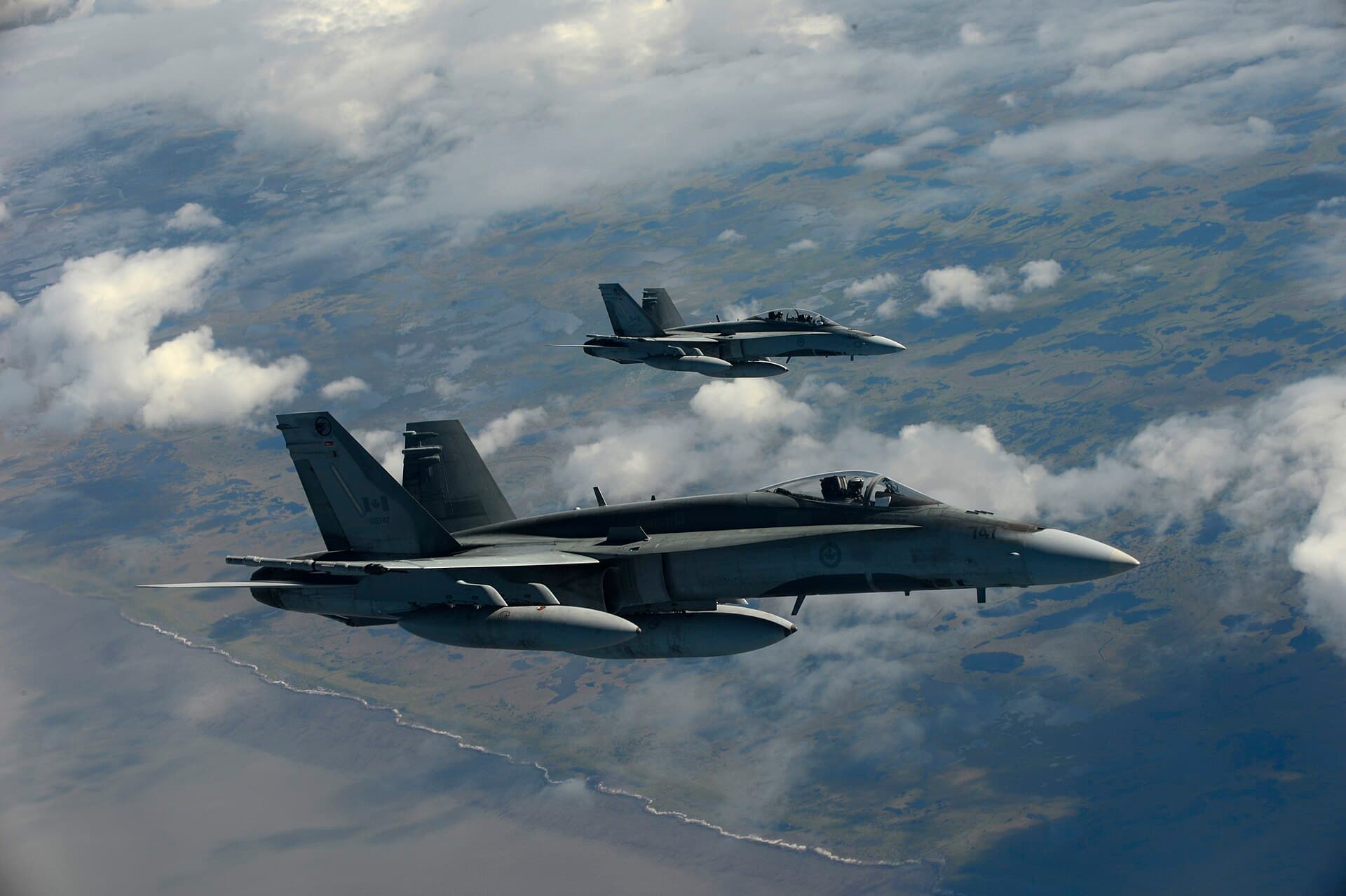
A Canadian CF-18A flies alongside US F-35A and F-16C fighters as NORAD intercepts a Chinese H-6K bomber off Alaska on 24 July 2024. File photo.
Ottawa's answer
McGuinty said he could not "divine" the thinking behind the messaging and that co-operation with the United States, directly or through NATO and NORAD, had not changed. "We're so busy executing on plans, acquisitions, rebuilding 33 bases, improving our recruitment, our retention," he said. Asked about the 5% pledge, he said Canada has a path to 4% of GDP by 2030 and is "on track".
His spokesperson, Simon Lafortune, said Canada has committed C$81.8 billion (about US$56.9 billion) over five years to rebuild its forces and reached NATO's old 2% benchmark ahead of schedule. Ottawa's latest budget projects combined defence and security spending of 4.1% of GDP by 2027-28, but only 2.6%, or roughly C$99 billion, on core military spending. NATO's Hague formula asks for 3.5% of GDP on core defence and 1.5% on related security.
Why it matters
This is the sharpest public US attack on Canada's military since the alliance-wide spending fight began, and it lands on the most sensitive file in Ottawa: the fighter fleet. Prime Minister Mark Carney put the F-35 order under review as President Donald Trump threatened Canadian sovereignty and imposed tariffs, and Saab's Gripen E is being studied as an alternative that could bring jobs to Canada. Our Gripen E vs F-35A comparison sets out what each option would mean for the RCAF.
The pressure is also selective. On Sunday, Pentagon policy chief Elbridge Colby praised Germany's build-up as a "tectonic shift" and called Poland a "true model ally", although most NATO members remain short of 5%. In May, Colby paused the Permanent Joint Board on Defense, a US-Canada body set up in 1940. Wesley Wark, a Canadian national security expert, called the latest criticism "insulting and infuriating". For NORAD, which depends on Canadian radars, bases and fighters to watch the northern approaches, the real test is whether the row stays rhetorical or starts to shape procurement and basing decisions.