Land3 min read
United States: Army Says Its First Dark Eagle Hypersonic Battery Is Now Fully Fielded
Lt. Gen. Frank Lozano, the Army's top acquisition officer for fires, says the first Dark Eagle hypersonic missile battery is "fully fielded" and ready, about three years after the original 2023 target. The Army has not issued a formal announcement, and batteries two and three still have no public dates.
By Michael Korten ·
The US Army's first battery of Dark Eagle hypersonic missiles is "fully fielded" and "ready to go," according to Lt. Gen. Frank Lozano, the service's Program Acquisition Executive for Fires. Lozano made the statement in an interview with Breaking Defense published on 25 November, but declined to say when or where the battery reached that status.
If it holds, the declaration closes a chapter of repeated slips. The Army first planned to field the Long-Range Hypersonic Weapon (LRHW) battery in 2023, moved the goal to September 2025 after problems with the launcher, and missed that too. As recently as October, Bloomberg reported that the battery was still not fully fielded, and the programme office said more training and sustainment work was needed before it could make that call. The Army has not issued a formal announcement of the new status.
Lozano did not dispute the October report. "This is a rapidly evolving space," he said, adding that ground equipment had been arriving since 2021, which makes it hard to name a single fielding date.
What a Dark Eagle battery is
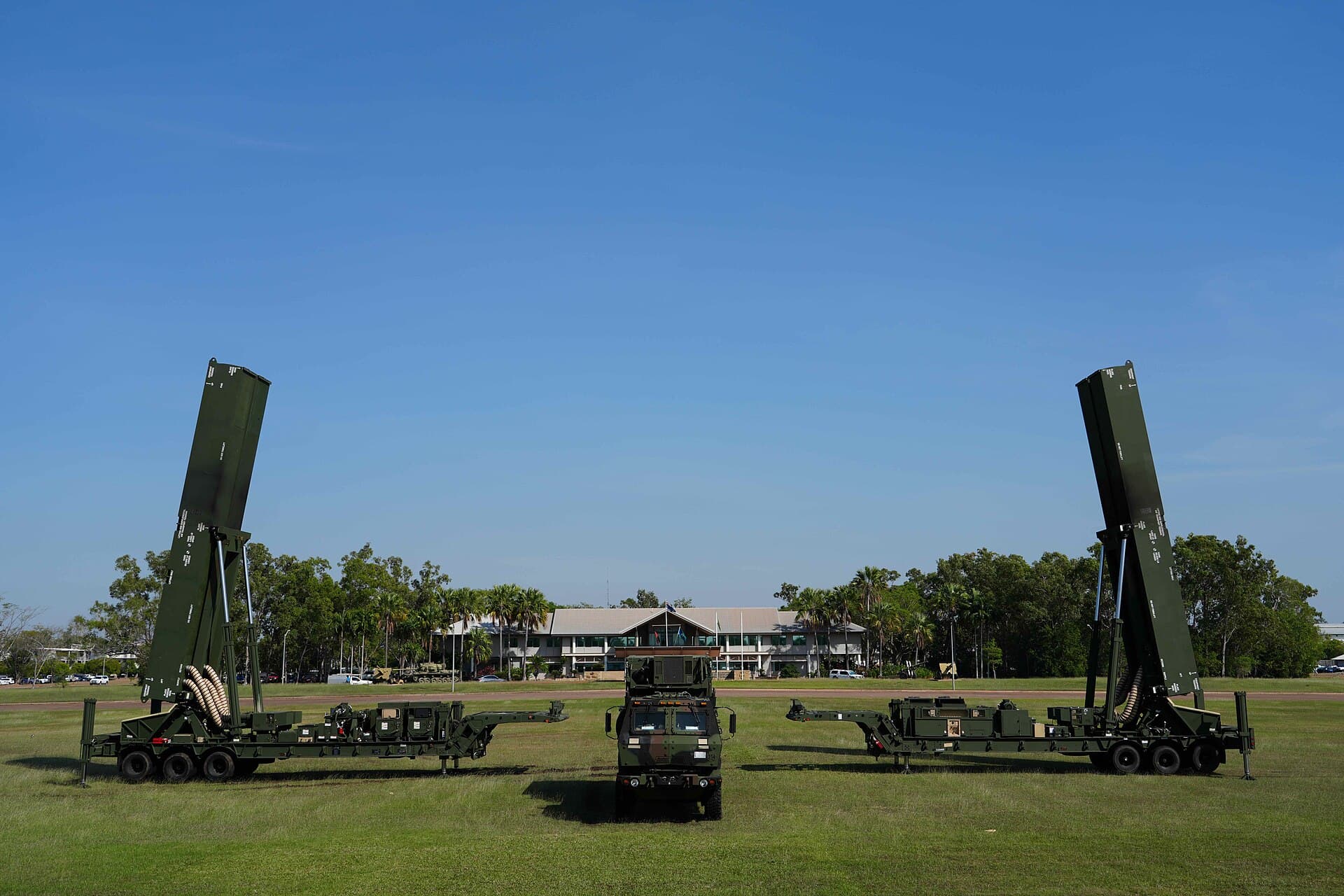
A battery has four trailer-mounted transporter-erector-launchers, each carrying two missiles in canisters, for eight ready rounds, plus a battery operations center and a support vehicle. Each missile pairs a two-stage rocket booster with the Common Hypersonic Glide Body, the same glide vehicle the Navy is adapting for its Conventional Prompt Strike weapon on Zumwalt-class destroyers and, later, Virginia-class submarines.
The Army credits the weapon with a range of 1,725 miles, about 2,775 km, and speeds above 3,800 mph, roughly five times the speed of sound. The unit designated to operate it, Bravo Battery, 1st Battalion, 17th Field Artillery Regiment of the 3d Multi-Domain Task Force, was activated at Joint Base Lewis-McChord, Washington, in December 2025. Launchers from the earlier Dark Eagle battery of the 5th Battalion, 3rd Field Artillery were shown in Australia's Northern Territory during Exercise Talisman Sabre in July 2025.

Dark Eagle launchers raised during Exercise Talisman Sabre 2025 in the Northern Territory, Australia. Each trailer carries two missiles. File photo.
Production is the next test
The harder question is how quickly more rounds arrive. A Government Accountability Office report in July said the Army and Navy had paused missile production to fix problems found in testing, and that prime contractor Lockheed Martin had continued to have issues at its facility, including missing and unclear work standards. GAO put the second battery in early 2027.
Lozano would not give dates for the second and third batteries, citing operational security. He said the third is "already over halfway through production" and that both should reach full capability faster than the first. He also wants competition: "I'd like to have two or three vendors all in production against a singular requirement," he said, describing a scaled hypersonics effort to fill the gap between Dark Eagle and cheaper, shorter-ranged weapons such as Castelion's Blackbeard.
Why it matters
Eight rounds is a small force, and each one is expensive: the Congressional Budget Office estimated in 2023 that a Dark Eagle missile costs about $41 million. But it is the first US land-based conventional weapon that can strike at intermediate range, more than five times the reach of the roughly 500 km Precision Strike Missile. Based in Japan or the Philippines, a 2,775 km weapon would cover much of the South China Sea and the Chinese coast. China put its DF-17 glide-vehicle missile on parade in 2019, and Russia declared Avangard operational the same year, so a single US battery is as much a catch-up step as a breakthrough. The Air Force is pursuing its own path with the air-launched ARRW. For Dark Eagle, the real measure will be whether batteries two and three arrive on the faster timeline Lozano promised.