Navy3 min read
China's Fourth Aircraft Carrier, the Nuclear-Powered Type 004, Could Launch in 2027
China's fourth aircraft carrier, the Type 004 under construction in Dalian, could be launched as early as 2027, analysts say. CSIS measured its hull at about 322 metres and rates nuclear propulsion as likely, which would make it China's first nuclear-powered carrier.
By Michael Korten ·
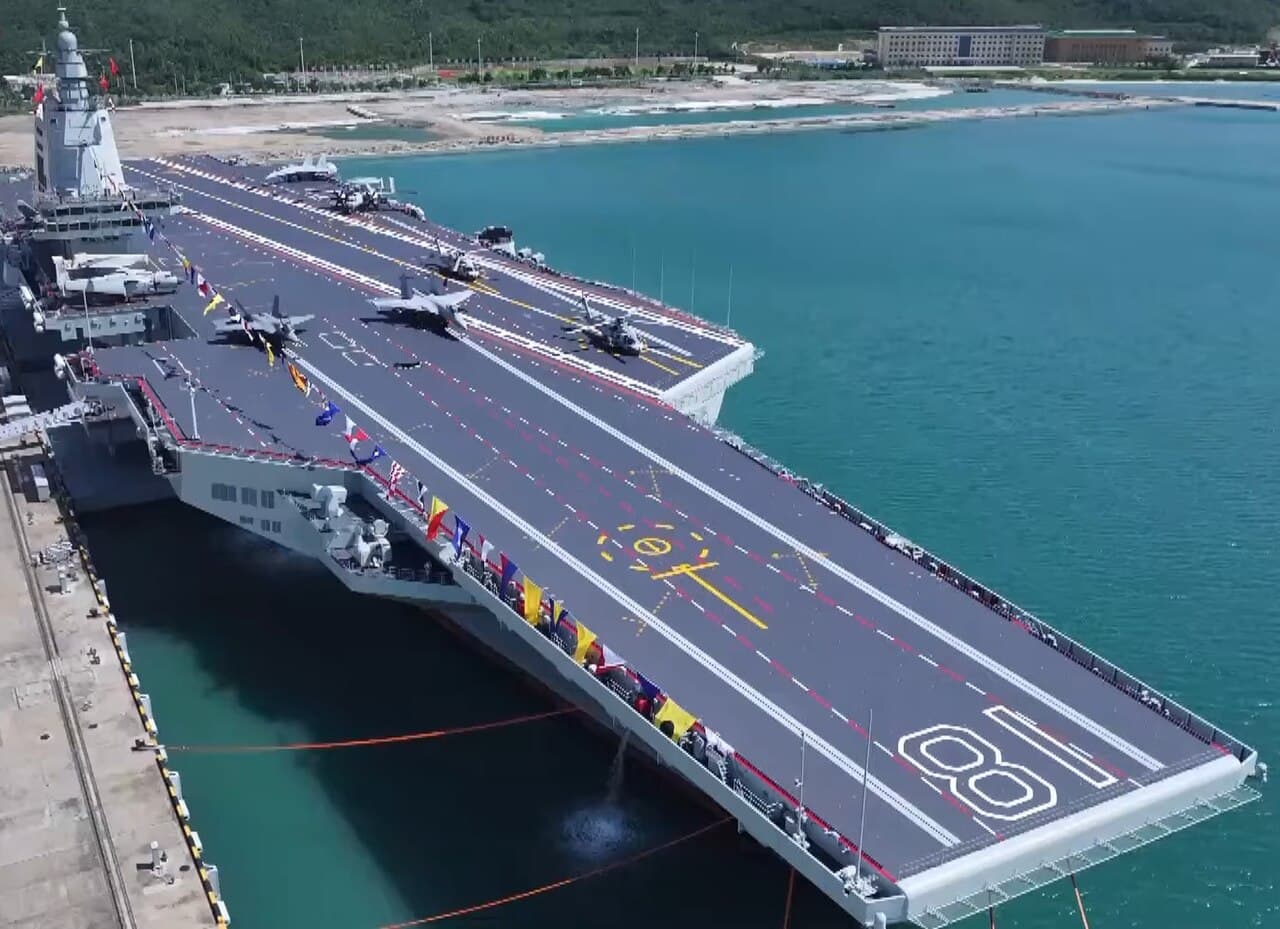
China's fourth aircraft carrier, known so far as the Type 004, could be launched as early as next year in the northern port of Dalian, analysts told Defense News on November 23. The ship is already larger than any of the three carriers China has commissioned, and it is likely to be the country's first nuclear-powered one.
- Hull measured at about 322 m long and 46 m wide in October 2026, according to CSIS satellite analysis
- CSIS rates nuclear propulsion as "likely" and four catapults and a third aircraft lift as "plausible"
- Analysts expect a launch around 2027, then five to 10 years before it is fully deployable
- Estimates of its air wing range from 75 to 90 aircraft up to about 100
The Center for Strategic and International Studies, which has tracked the build with commercial satellite imagery, called the Type 004 "far larger than any other class of surface combatant" in the Chinese navy. Prefabricated hull blocks first appeared in a Dalian dry dock in early 2025; by October 2026 they had become a clearly recognisable hull.
How close it is
CSIS says the carrier is at roughly the stage the Fujian, China's third carrier, had reached in May 2021. The Fujian was launched about a year after that, which points to a 2027 launch for the Type 004. "Basic hull form" is already in place, said Collin Koh of Nanyang Technological University in Singapore, but he expects five to 10 years of fitting out, trials and training before it is fully operational.
China has not confirmed that the ship is nuclear-powered. If it is, it would have "essentially unlimited endurance" and could deploy globally without the tanker support conventionally powered carriers need, said David Silbey of Cornell University. Koh said nuclear power would also feed the electromagnetic catapults directly, allowing faster launches of fully loaded aircraft. "It seems to signal a certain global ambition," he said.

A J-15T fighter is launched by electromagnetic catapult from the Fujian, November 2025. Analysts expect the Type 004 to pair catapults with nuclear power. File photo.
From three carriers to nine
China's first two carriers, Liaoning and Shandong, are conventionally powered and launch aircraft from a ski-jump bow. The Fujian, commissioned in November 2025, introduced electromagnetic catapults and flies the J-35 stealth fighter and the KJ-600 airborne early warning aircraft. The Type 004 would add nuclear power and more aircraft on top of that.
Alexander Huang of Taipei's Council of Strategic and Wargaming Studies said the new carrier may be based in northern China, since the other three are in the south, giving the navy enough hulls to keep one at sea at all times. The 2025 US Department of Defense report on China's military assessed for the first time that Beijing aims to field six more carriers by 2035, for a total of nine. That would mean building at least two at once, with Jiangnan Shipyard in Shanghai, which built the Fujian, the obvious second yard.
Why it matters
The US Navy has 11 carriers, all nuclear-powered, and a big lead in experience. But a Chinese supercarrier in the 300-metre class, with catapults and a large air wing, closes much of the gap in what a single ship can do, and would let the People's Liberation Army Navy operate further from China's coast than its land-based air power reaches. For Japan, the Philippines and US forces in the western Pacific, the Type 004 is the clearest sign yet that China's carrier force is being built for blue water, not just for its near seas.