UAV7 min read
Kizilelma Enters Service as Turkey Becomes the First Country to Field an Unmanned Fighter Jet
Baykar has delivered the first three Bayraktar Kizilelma unmanned fighters to Turkish security forces after acceptance tests. No other country has yet put a jet-powered unmanned fighter into operational service. This is a full guide to the aircraft: its radar, weapons, performance, test record and buyers.
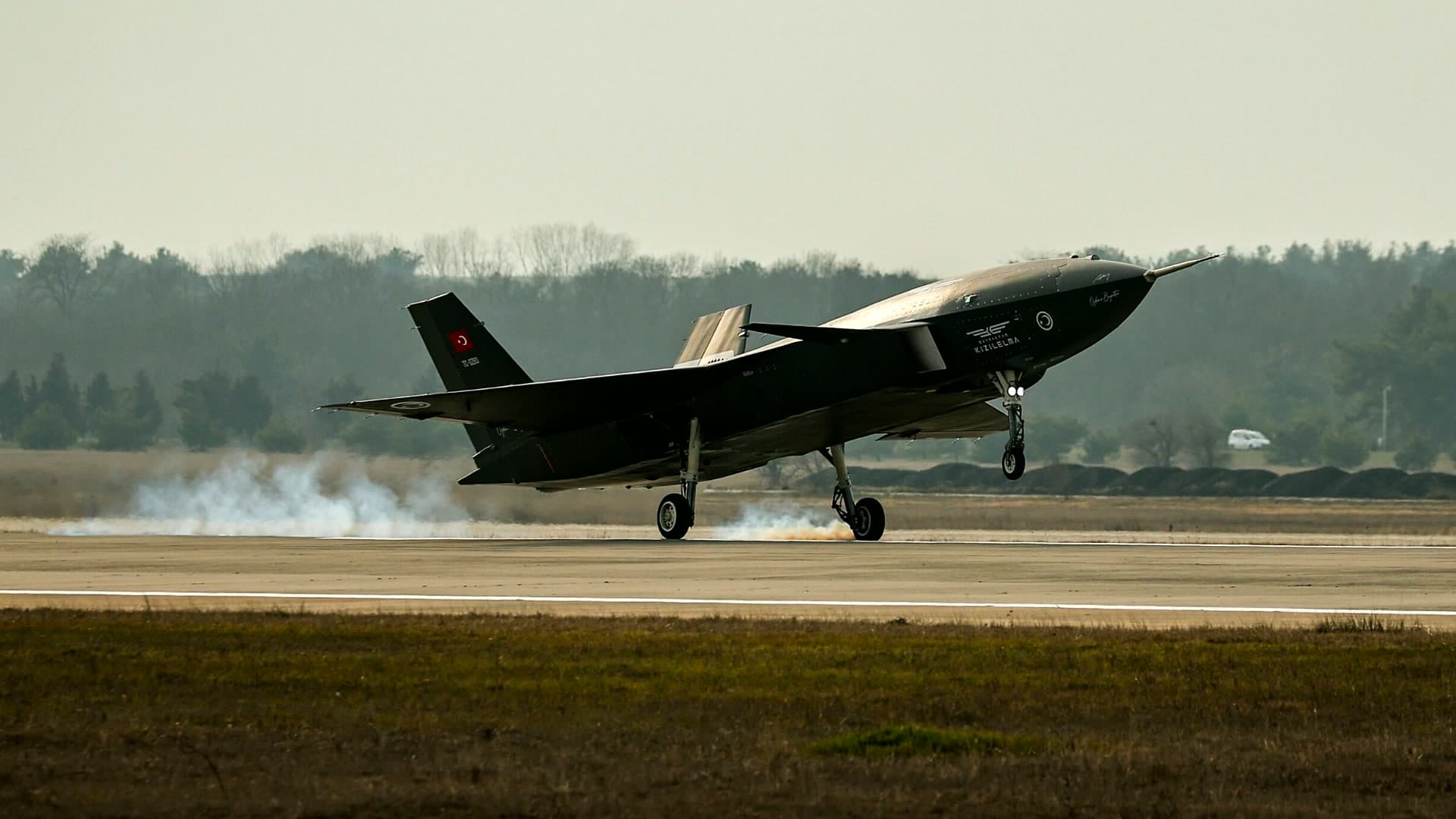
Turkey now has unmanned fighter jets in service. Baykar announced on Thursday, November 19, that the first three Bayraktar Kizilelma aircraft had completed acceptance tests, been handed over to Turkish security forces and started active duty. The company said this makes Turkey the first country in the world to put an unmanned fighter into its operational inventory.
"We are delivering to our nation today the dream we set out on 20 years ago," Baykar said in its statement, which also remembered the company's late founder, Ozdemir Bayraktar. The aircraft had flown 600 test and training sorties before delivery. Baykar did not name the unit that received them, saying only that they went to the "security forces".
Burhanettin Duran, head of the Turkish Presidency's Communications Directorate, called the delivery "a world first" and "an important sign of our country's engineering power, technological know-how and strategic vision". Baykar chairman and chief technology officer Selcuk Bayraktar pointed to a record the company has repeated often: Kizilelma is still the only unmanned fighter to have shot down an air target that it found with its own radar, using its own missile.
Is it really the first?
On the narrow claim, yes. Several countries are building jet-powered combat drones designed to fight alongside or instead of crewed fighters, but none has announced one in operational service.
- United States: the Air Force decided on June 17, 2026, to put its Collaborative Combat Aircraft, the FQ-42A and FQ-44A, into production. More than 150 are planned through 2030, but they are not yet in service.
- Australia: Boeing's MQ-28 Ghost Bat is still in testing and early production.
- China: open-source analysts have suggested that the GJ-11 stealth combat drone is in service, but Beijing has never confirmed it.
Russia's S-70 Okhotnik and the various "loyal wingman" projects in Europe, India and South Korea are further behind. Three aircraft is a small fleet, and an initial delivery is not the same as a fully operational capability. But Turkey is the first country to say officially that an unmanned fighter is in its inventory and on duty.
From a 2021 concept to the flight line
Kizilelma, Turkish for "red apple", a traditional symbol of a distant goal, went from concept to delivery in about five years.
- July 20, 2021: Baykar revealed the concept.
- March 12, 2022: the first prototype entered the production line.
- December 14, 2022: first flight at Corlu, Tekirdag.
- April 2023: formation flight with an Akinci drone, then formation flights with the Turkish Stars and SoloTurk display teams at Teknofest Istanbul.
- October 8, 2025: first live firings, with TOLUN and TEBER-82 munitions.
- November 17, 2025: ASELSAN's TOYGUN electro-optical targeting system integrated.
- November 29, 2025: off Sinop, Kizilelma detected a jet-powered target drone with its MURAD AESA radar and destroyed it with a GOKDOGAN beyond-visual-range air-to-air missile.
- December 27, 2025: two Kizilelmas flew a close autonomous formation, a test of swarm autonomy.
- May 20, 2026: autonomous formation flight with Italian M-346 jets.
- July 2026: a JET-230 supersonic missile hit its target from more than 120 km at Merzifon, and the first weapons were dropped from the internal bay.
- November 19, 2026: first three aircraft delivered.

Kizilelma (top) flies in formation with Turkish Air Force F-16s. Baykar sees the unmanned fighter working alongside crewed jets. File photo.
What Kizilelma is
Kizilelma is a single-engine, jet-powered aircraft about the size of a light fighter, with no cockpit. Baykar describes it as an unmanned fighter, not a drone that carries weapons: it is built for air-to-air combat as well as strikes, with a high level of manoeuvrability and a shape designed to reduce its radar cross-section.
The design shows that intent. The air intakes sit on either side of the fuselage, the twin tails are canted outwards, and the weapons can be carried inside the fuselage, all of which reduce its radar signature. Like most aircraft built with low observability in mind, it can also carry weapons under its wings when stealth matters less than payload. Baykar's figures for the aircraft:
- Length: 14.5 m. Wingspan: 10 m. Height: 3.5 m.
- Maximum takeoff weight: 8,500 kg, with 1,500 kg of payload.
- Speed: cruise at Mach 0.6, maximum Mach 0.9.
- Altitude: 25,000 ft operational, 40,000 ft service ceiling.
- Mission radius: 500 nautical miles (about 925 km).
- Endurance: more than three hours.
- Control: line-of-sight and satellite (beyond-line-of-sight) data links; takeoff, landing, taxiing and cruise are fully autonomous.
Kizilelma is subsonic. It is not meant to outrun crewed fighters, but to go where a pilot would be at risk, in numbers that crewed fighters cannot match.

A Baykar rendering of Kizilelma. The air intakes sit on either side of the fuselage, the twin tails are canted outwards and weapons can be carried internally.
The sensors
Baykar lists three sensor types for the aircraft, all of them now built in Turkey.
- MURAD AESA radar (ASELSAN): an active electronically scanned array in the nose. This is what makes Kizilelma a fighter rather than a strike drone: it can find and track air targets itself and guide missiles at them, as it did in the November 2025 GOKDOGAN shot.
- TOYGUN electro-optical targeting system (ASELSAN): cameras and a laser designator for finding, identifying and marking ground targets for guided weapons.
- Infrared search and track (IRST): a passive sensor that detects aircraft by their heat, without the radar emissions that would give Kizilelma away.
The weapons
Kizilelma has fired a wide range of Turkish weapons in testing:
- GOKDOGAN (TUBITAK SAGE): a radar-guided, beyond-visual-range air-to-air missile. Its November 2025 kill made Kizilelma the first unmanned fighter to destroy a jet-powered air target with such a missile.
- JET-230 (Roketsan): a supersonic air-to-ground ballistic missile. In July 2026 it hit its target from more than 120 km away; Baykar puts its range at over 200 km.
- TOLUN: a guided glide bomb for standoff strikes.
- TEBER-82: a guidance kit that turns an unguided 500-pound bomb into a precision weapon.
TOLUN and TEBER-82 have been dropped from the internal weapons bay, the most important test for a low-observable aircraft. Baykar also lists INS/GPS- and laser-guided munitions, standoff weapons, cruise missiles and mini cruise missiles as planned payloads.

Kizilelma at a glance: 14.5 m long, 10 m wingspan, 3.5 m high, with its sensors and the weapons it has fired in testing. Militrax graphic based on Baykar data.
Variants, engines and the ship

Kizilelma's engine running with afterburner during a ground run. TC-OZB3 on the tail is the aircraft's registration. File photo.
Baykar names five versions, KIZILELMA-A, -B, -CA, -CB and -D, but has not explained in detail how they differ. Baykar describes the power plant only as a turbofan engine, and the photo above shows it running with an afterburner. Turkish engine maker TEI is developing the TF6000 turbofan for domestic unmanned jets.
Kizilelma was also conceived with the short deck of the amphibious assault ship TCG Anadolu in mind, and a prototype was displayed on the ship's deck in April 2023. Baykar says work on operating the aircraft from short-deck carriers is continuing. If it succeeds, it would give the Turkish Navy a jet-powered strike aircraft at sea, something the F-35B was meant to provide before Turkey was removed from that programme.
Who is buying, and how many
Turkey has not said how many Kizilelmas it plans to buy, or how quickly. The first three are a starting point, and the next deliveries will show how quickly Baykar can build them.
The first export customer is Indonesia. On May 6, 2026, Baykar chief executive Haluk Bayraktar announced a framework agreement for a first fleet of 12 aircraft, with deliveries planned from 2028 and options for another 48. That would bring Jakarta's total to 60 if all options are taken. Baykar sells its TB2 and Akinci drones to more than 30 countries, and many of them are likely to be interested in Kizilelma as well.
What we still don't know
Several important questions remain open. Baykar has not said which service or unit is flying the first aircraft, how many the Turkish armed forces will buy, what each aircraft costs, or what the production rate will be. Nor has it said which variant was delivered. The answers will show whether Kizilelma becomes a large fleet or a small, specialist force.
Why it matters
Kizilelma is part of a bigger Turkish plan. It is meant to fly alongside the KAAN, the national fifth-generation fighter, and Turkey's F-16s, scouting ahead, carrying extra missiles and taking risks that would be unacceptable for a crewed jet. That is the same idea behind the US CCA programme. The difference is that Turkey has got there first.
For Baykar, the delivery strengthens the company's position. The TB2 changed how armed drones were used in wars from Libya to Ukraine. Kizilelma aims to do the same for jet-powered unmanned air combat. Three aircraft will not change the balance of power in the region on their own. But they show that unmanned fighters are no longer only an idea; one is now in service.