Poland Nears Full Delivery of 250 M1A2 SEPv3 Abrams Tanks as NATO's Eastern Flank Hardens
The United States has delivered 217 of the 250 M1A2 SEPv3 Abrams tanks ordered by Poland, with the final 33 expected by the end of 2026, completing one of the largest armour deals in NATO since the Cold War.
Poland is close to completing one of the largest tank purchases in NATO's recent history. The United States has now delivered 217 of the 250 M1A2 SEPv3 Abrams main battle tanks ordered by Warsaw, and the final 33 are expected to arrive before the end of 2026.
When the last tanks are handed over, Poland will operate the most modern version of the Abrams in larger numbers than any other country outside the United States. Combined with older Abrams already in service, South Korean K2 tanks and German Leopards, the Polish Army is turning into the most powerful armoured force on NATO's eastern flank.
The deliveries have accelerated through 2026. In June, Poland's Ministry of National Defence said 36 tanks had been handed over that month, bringing the total to 182. A further batch of 35 tanks arrived in September, raising the total to 217. The remaining vehicles are scheduled for the fourth quarter, in line with the plan to complete the order this year.
Poland signed the government-to-government agreement for 250 M1A2 SEPv3 tanks in April 2022, only weeks after Russia launched its full-scale invasion of Ukraine. The deal is valued at about $4.75 billion. Besides the tanks themselves, it includes 26 M88A2 Hercules armoured recovery vehicles, 17 M1074 Joint Assault Bridge vehicles, ammunition, training and a logistics support package.
The SEPv3, short for System Enhancement Package version 3, is the latest production standard of the Abrams. It keeps the tank's 120 mm smoothbore gun and 1,500-horsepower gas turbine engine, but adds improved power generation, upgraded electronics, better sights and networking, and armour improvements. It is designed to accept new ammunition types and future upgrades more easily than older Abrams versions.
Poland did not wait for the new tanks to start building its Abrams force. Warsaw first received 28 older M1A2 SEPv2 tanks on loan for crew training while the SEPv3 tanks were being produced. In 2023, Poland also bought 116 used M1A1 Abrams in the FEP configuration from U.S. Army stocks, which were delivered quickly to give units hands-on experience with the type.
Training has been built alongside the deliveries. U.S. Army units set up an M1A2 Abrams training academy at Biedrusko Training Area in 2023, where Polish crews learned to operate and maintain the tank. In January 2024, the first Polish tank crew qualified on an M1A2 Abrams at Nowa Dęba Training Area after training with soldiers from the U.S. 1st Armored Division.
The new tanks are going to units that sit at the heart of Poland's defence plans. The 1st Warsaw Armoured Brigade, responsible for the defence of the capital, has received SEPv3 tanks, and the 18th Mechanised Division, created in 2018 to strengthen the country's eastern regions, is the main Abrams formation. These units face the most direct threat from Russia and Belarus.
Taken together, Poland's plans call for more than 360 Abrams tanks in service: the 250 SEPv3 tanks plus the 116 M1A1 tanks. That is a major force on its own, but it is only one part of the picture.
Poland has also bought Hyundai Rotem K2 Black Panther tanks from South Korea. The first contract, signed in 2022, covered 180 tanks, and a second contract for another 180 followed in 2025, with part of the production planned to move to Poland. Warsaw still operates Leopard 2 tanks and locally developed PT-91 Twardy tanks, a modernised version of the Soviet-era T-72. Polish officials have spoken about a future tank fleet well above 1,000 vehicles.
The scale reflects how seriously Warsaw takes the threat on its border. Poland shares a frontier with Belarus and with Russia's Kaliningrad exclave, and the narrow Suwałki Gap between them is one of NATO's most sensitive points. Poland now spends more than 4 percent of its gross domestic product on defence, among the highest levels in the alliance, and has made the army's armoured forces a top priority.

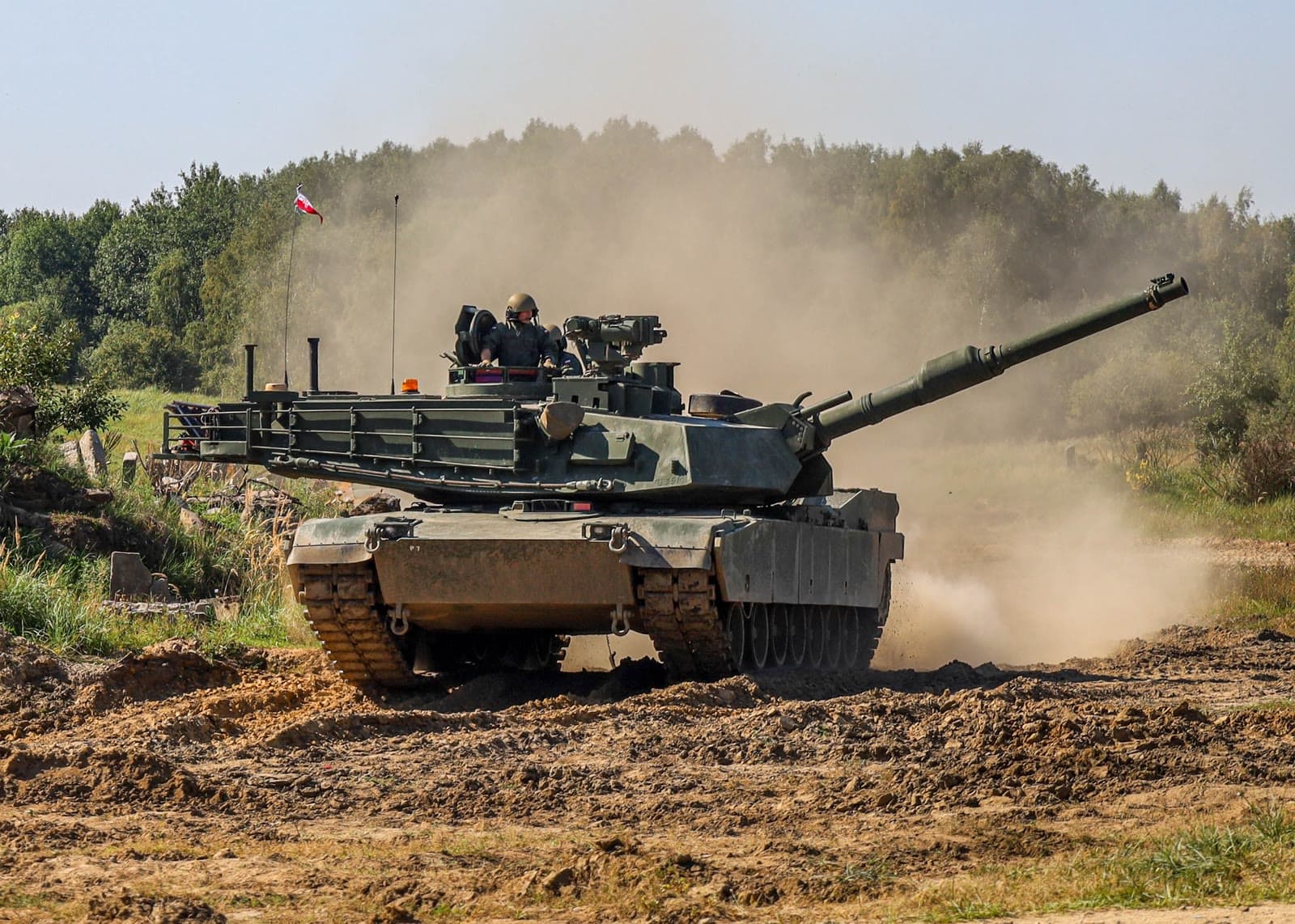
A Polish-crewed M1A2 Abrams fires during crew gunnery qualification at Nowa Dęba Training Area, Poland. Polish Armed Forces photo via DVIDS.
The Abrams also carries a strong political message. By choosing an American tank for a large part of its armoured force, Poland has tied its land forces closely to the U.S. military. Polish crews train with American units, use American logistics and can work smoothly alongside the U.S. armoured brigades that rotate through Poland. That interoperability is a key part of NATO deterrence on the eastern flank.
There are challenges. The Abrams is a heavy and demanding tank, and its gas turbine engine burns more fuel than diesel-powered rivals. Running three main battle tank families at the same time also puts pressure on training, spare parts, maintenance and ammunition supply. Poland is working with the United States to set up local production of Abrams spare parts, an effort meant to keep the fleet ready without relying entirely on shipments across the Atlantic.
Infrastructure is another issue. Heavy tanks need bridges, rail links, maintenance depots and training areas that can handle their weight. Poland has invested in new bases and logistics hubs, and the Joint Assault Bridge vehicles in the Abrams package will help units cross gaps quickly in the field.
The Abrams deal is also part of a wider shift across Europe. Romania is planning to buy 54 Abrams tanks, while Germany, France and the United Kingdom are investing in Leopard 2A8, upgraded Leclerc and Challenger 3 programmes. After decades of cuts, heavy armour has returned as a central part of European defence planning.
For Poland, completing the SEPv3 order will close an important chapter. In less than five years, Warsaw will have moved from signing the contract to fielding a full fleet of 250 modern Abrams tanks, while also building up K2 and other armoured programmes in parallel.
Few countries in Europe have moved as fast. When the last 33 tanks arrive, Poland will not only have one of the largest tank fleets in NATO, but also one of the most modern. For an alliance that is trying to strengthen deterrence along its eastern border, that is one of the clearest signs of how quickly the military balance in Central Europe is changing.
The Militrax Weekly
The week's defense news, in one email.
Deals, deliveries and new weapons from every theater, explained. Every Sunday, free, no spam.
Read Next
Germany Must Be Able to Move 800,000 Allied Troops East in 30 Days, Defence Official Says
US Army Wants Drone-Killing Air Defense on Pallets by the End of 2029
Diehl Opens New 155mm Shell Body Line in Germany as Europe Races to Make More Artillery Ammunition
France Warns Germany Its Long-Range Missiles Could Push Russia Toward the Nuclear Threshold
Patriot vs SAMP/T NG: How Europe's Two Long-Range Air Defence Shields Compare