Norway Receives First M3 Amphibious Bridge as NATO Rebuilds River-Crossing Power
Norway has taken delivery of its first M3 amphibious bridging and ferry system from General Dynamics European Land Systems, less than a year after signing the contract, becoming the sixth NATO country to operate the system.
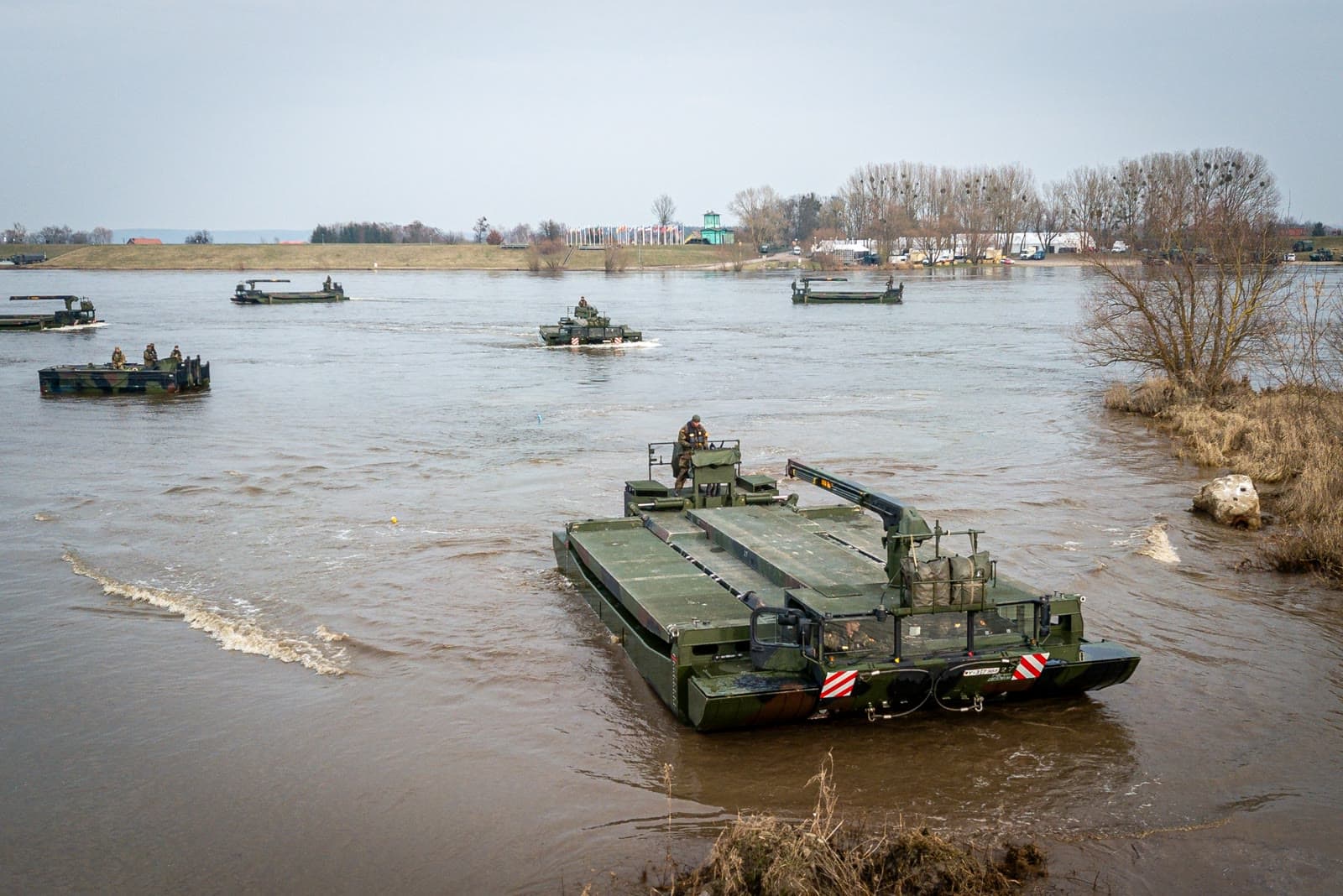
Norway has received its first M3 amphibious bridging and ferry system from General Dynamics European Land Systems (GDELS), giving the Norwegian Army a new way to move tanks and heavy vehicles across rivers and fjords, and making Norway the sixth NATO country to operate the system.
The first vehicle was handed over to the Norwegian Defence Materiel Agency, known as Forsvarsmateriell, at GDELS's facility in Kaiserslautern, Germany, on November 4. The handover came less than a year after the contract was signed in November 2025. The order is worth about NOK 1.2 billion, and deliveries are planned to continue from autumn 2026 until 2028.
Norwegian officials have described the speed of the programme as exceptional. Tomas Beck, head of land and joint capabilities at the agency, called it the fastest delivery of this complex military capability ever made to a nation. Defence Minister Tore O. Sandvik described the M3 as a reinforcement and a much-needed renewal of the army's ability to cross water obstacles.
The first vehicle has been named Bara, after a figure from Norse mythology. It is expected to arrive in Norway by the end of 2026. According to the project manager at Forsvarsmateriell, the first systems are not expected to enter operational service before autumn 2027, as crews and technicians still need to be trained and procedures built up around the new equipment.
The M3 is a self-propelled amphibious vehicle that can drive on roads like a large truck and then enter the water. Once afloat, a single M3 can act as a ferry, carrying a vehicle across a river. Several M3s can also lock together side by side to form a floating bridge. According to the manufacturer, eight vehicles can build a bridge of about 100 metres in under ten minutes.
That speed is the system's main advantage. Traditional bridging often requires engineers to bring in pontoons by truck, unload them and assemble them in the water, a process that takes longer and leaves units exposed. The M3 drives straight into the river, unfolds its ramps and is ready to carry traffic almost immediately.
The M3 has a 4x4 chassis, a road speed of up to 80 km/h, and two waterjets that can rotate 360 degrees for movement in the water. Each vehicle needs a crew of two to three soldiers. It can carry all NATO vehicles, including the heaviest main battle tanks. It can also connect with standard ribbon-type floating bridges using special adapters, which makes it easier to combine with other allied bridging equipment.
Norway's version, sometimes called the M3N, is closely based on the Swedish configuration. Norway joined a production line already running for Sweden, cooperating with the Swedish Defence Materiel Administration (FMV), which helped speed up the contract and delivery. The two countries' versions are expected to differ only in minor details.
This matters for the Nordic region. Norway is the third member of the Nordic Defence Cooperation framework, NORDEFCO, to buy the M3, after Sweden and Denmark. With all three operating the same system, their engineer units can train together, share know-how and in principle use each other's vehicles. Across NATO, the M3 is also operated by Germany, the United Kingdom and Latvia, and the system is designed so that units from different user nations can work together on the same crossing.
The terrain explains why Norway wants this capability. The country is long and narrow, cut by fjords, lakes and rivers, and much of its northern territory is remote with limited road networks. In a crisis, moving armoured units quickly to the north, especially toward Finnmark and the border with Russia, would require crossing many water obstacles. Bridges could be damaged, destroyed or simply too weak for heavy armour.

U.S. Army M1A2 Abrams tanks cross the Elbe River in Germany on German M3 amphibious rigs during exercise Heidesturm Shock. U.S. Army photo via DVIDS.
The M3 is suited to all climate zones, including Arctic conditions. For Norway, where winter operations, cold water and difficult shorelines are part of normal planning, that is an essential requirement. The ability to operate from unprepared riverbanks also gives commanders more options when choosing where to cross.
The purchase comes as Norway strengthens its army after years of limited investment. Oslo has committed to a major increase in defence spending under its long-term defence plan, and the army is receiving new Leopard 2A8 tanks, K9 howitzers and other equipment. Heavy tanks are of little use if they cannot cross rivers, so bridging is a key part of making the new armoured force mobile.
Across NATO, river crossing has returned as a priority. During the Cold War, Western armies trained heavily for wet gap crossings, expecting to fight across Europe's rivers. After the Cold War, many of those skills and much of that equipment were reduced. The war in Ukraine has shown again how difficult and dangerous river crossings can be, with drones, artillery and surveillance making any crossing point a target.
The answer for many armies is speed. The faster a bridge can be built and used, the less time it remains exposed. The M3's ability to deploy quickly and then disperse makes it one of the most valued engineer systems in NATO. In October 2025, Germany and the United Kingdom also ordered a new generation of M3 vehicles through the European armaments agency OCCAR, under their joint Wide Wet Gap Crossing programme.
The M3 has also been tested in real NATO exercises across Europe. German and British M3 units have carried allied tanks across the Elbe, Weser and Vistula rivers, and have supported NATO battlegroups in Lithuania and Poland. These exercises show the system's role in moving allied forces quickly toward the eastern flank.
For GDELS, the Norwegian contract adds another customer to a growing user base and strengthens the company's position in the European bridging market. For Norway, it fills a gap that had become more visible as the army modernised its armour and NATO shifted its focus back to high-intensity warfare.
The first Norwegian M3 will spend the coming months on training and testing before it becomes part of the army's operational structure. But the message of the delivery is already clear. Norway is investing not only in tanks and artillery, but also in the less visible equipment that allows those forces to move, cross obstacles and reach the places where they are needed.
Sources
The Militrax Weekly
The week's defense news, in one email.
Deals, deliveries and new weapons from every theater, explained. Every Sunday, free, no spam.
Read Next
Germany Must Be Able to Move 800,000 Allied Troops East in 30 Days, Defence Official Says
US Army Wants Drone-Killing Air Defense on Pallets by the End of 2029
Diehl Opens New 155mm Shell Body Line in Germany as Europe Races to Make More Artillery Ammunition
France Warns Germany Its Long-Range Missiles Could Push Russia Toward the Nuclear Threshold
Patriot vs SAMP/T NG: How Europe's Two Long-Range Air Defence Shields Compare