Air2 min read
EU Puts €68 Million Into Research to Detect and Intercept Hypersonic Glide Vehicles
The European Defence Fund's 2026 work programme sets aside €68 million for research into countering hypersonic glide vehicles, the European Commission said. The money sits alongside EU-funded work on laser weapons, new sensors and anti-jamming networks aimed at prototypes by 2027.
The European Union will put €68 million into research on defending against hypersonic glide vehicles, the European Commission said, as part of the European Defence Fund's 2026 work programme. These weapons glide and manoeuvre at more than five times the speed of sound, which makes them hard to detect, track and intercept with today's air defences.
The money is part of a wider EU push on early warning and interception of hypersonic threats. The Commission also named advanced sensors, laser weapons, nanotechnology and next-generation communications as priorities for Europe's defence readiness.
Why glide vehicles are so hard to stop
A ballistic missile warhead flies a high, predictable arc. A glide vehicle is boosted by a rocket, then separates and skims through the upper atmosphere at hypersonic speed, lower than a ballistic warhead and able to change course. That keeps it below the horizon of ground-based radars for longer and makes its final target hard to predict until late in the flight. Russia already fields the Avangard glide vehicle and China the DF-17 missile.
Most of today's interceptors were built either to hit ballistic warheads outside the atmosphere or to defend a small area in the final seconds. The long middle part of a glide vehicle's flight, the so-called glide phase, falls between the two, and that is where Europe's research money is aimed.

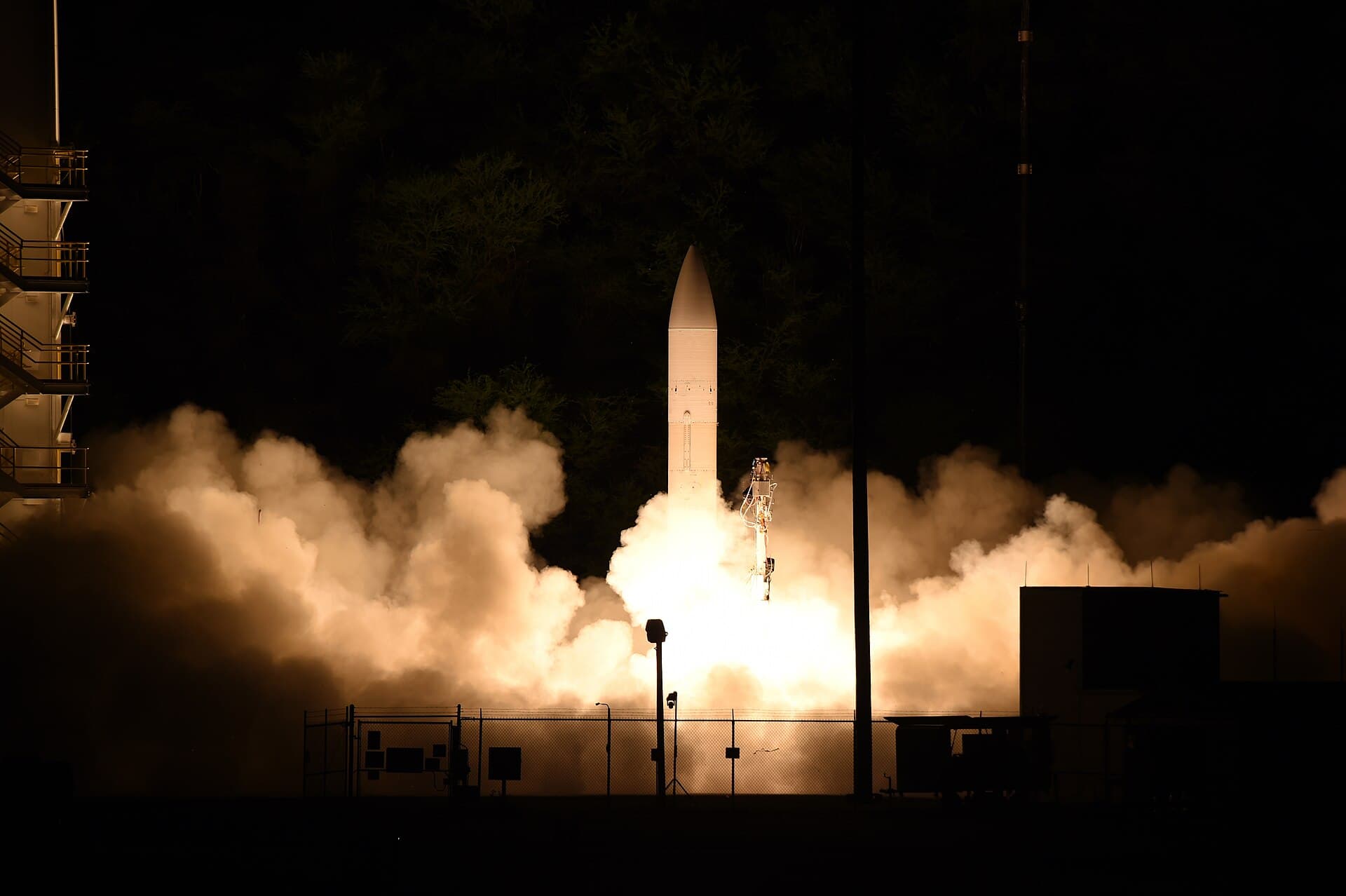
An SM-3 Block IB interceptor launches from the cruiser USS Lake Erie during a US Missile Defense Agency test in the Pacific in 2013. Interceptors like it were designed for ballistic missiles, not manoeuvring glide vehicles. File photo.
The new funding builds on earlier work. Previous EDF calls paid for two competing studies of a European endo-atmospheric interceptor: HYDEF, led by Spain's SENER, and EU HYDIS², led by MBDA. Separately, the EU's PESCO framework runs TWISTER, a project for space-based early warning and a future interceptor.
Lasers, sensors and networks
The fund has already invested more than €300 million in joint research on advanced sensors, including new radar, AI-assisted signal detection, sensor networking and quantum sensing, to help forces spot and track threats faster and keep working when signals are jammed.
It is also backing three laser projects, TALOS, TALOS-TWO and LACE, with the aim of a directed-energy weapon prototype by 2027. The Commission said lasers could cost less per shot than conventional interceptors, a potential advantage against swarms of cheap drones. Other EDF work covers nanomaterials for protection, coatings and camouflage, with smart-textile and adaptive-camouflage prototypes due by 2027, and secure communications using 5G, 6G, AI-enabled networks and laser links.
Why it matters
€68 million is research money, not an air defence system. Fielding an interceptor that can catch a manoeuvring glide vehicle will cost many times more and take years beyond the current programme. The EDF's whole budget for 2021–2027 is just under €7.3 billion, mostly paid out as grants that can cover up to 100% of eligible costs.
Still, the gap is real. Europe has no interceptor built for the glide phase today, and Russia has shown it is willing to fire hypersonic weapons in Ukraine. Funding the sensors, the detection algorithms and the interceptor studies now is how Europe avoids having to buy the whole answer from someone else later.