US Approves $1.08 Billion Black Hawk Sale to Mexico as Counter-Narcotics Airlift Grows
The U.S. State Department has approved a possible $1.08 billion sale of 11 UH-60M Black Hawk helicopters to Mexico, a package meant to modernise the Mexican helicopter fleet and expand airlift for operations against drug trafficking groups.
The United States has approved a possible sale of 11 UH-60M Black Hawk helicopters to Mexico in a package valued at about $1.08 billion, a move that would give Mexican forces more modern lift for operations against drug trafficking networks and further tie Mexico's military aviation to American equipment.
The State Department cleared the potential Foreign Military Sale on November 6. Sikorsky, the Lockheed Martin company that builds the Black Hawk, is named as the principal contractor. The approval is not a signed contract. It allows Mexico to move ahead with negotiations, and the final number of aircraft, equipment and cost can still change before any deal is concluded.
The package is larger than the helicopters alone. Mexico has asked for 27 General Electric T700-GE-701D engines, including five spares, along with 27 embedded navigation systems with GPS and 27 military communication radios. Reports on the notification also list electro-optical and infrared sensor turrets with laser designation, ballistic protection for the crew, M134 rotary machine guns, night vision equipment, rescue hoists, auxiliary fuel tanks and equipment for fast-rope insertion of troops.
That list says a great deal about how the aircraft will be used. These are not VIP transports or simple utility helicopters. A Black Hawk fitted with a sensor turret, door-mounted miniguns, armour, night vision and rope-insertion gear is built to find targets, move security teams quickly and put them on the ground in difficult terrain, often at night and under fire.
The stated purpose of the sale matches that picture. The package is intended to modernise Mexico's rotary-wing fleet, reduce the number of different helicopter types in service and improve airlift for counter-narcotics operations. The U.S. side also says the sale supports American foreign policy and national security goals by strengthening a partner's ability to fight organised crime, without changing the basic military balance in the region.
The deal would also bring a long-term American presence. The notification foresees about 15 U.S. government or contractor representatives working in Mexico for an extended period to support the introduction of the aircraft, training and maintenance. No offset agreements have been recorded.
Mexico is not new to the Black Hawk. The Mexican Air Force received its first two S-70A-24 helicopters in 1991, followed by more in the mid-1990s. The Mexican Navy received UH-60M aircraft from 2011, including helicopters delivered under the Mérida Initiative, the U.S.-Mexico security cooperation framework, and now operates about ten of them. In 2014, the Mexican Air Force ordered 18 UH-60M helicopters, with deliveries starting in late 2015. Sikorsky has said that Mexico acquired dozens of Black Hawk family helicopters over the past three decades.
The new approval does not say which Mexican service would receive the 11 additional aircraft. Both the Air Force, which is part of the Secretariat of National Defense, and the Navy have used Black Hawks heavily in security operations. The choice will matter, because each service has its own bases, training pipelines and mission priorities.
What is clear is that the helicopter has become one of Mexico's most important tools in the fight against organised crime. Large parts of the country are mountainous, roads can be slow or dangerous, and criminal groups often operate in remote areas. Helicopters allow security forces to move troops quickly, carry out raids, evacuate wounded personnel, supply isolated units and support disaster relief.
Fleet age is a growing problem. Many of Mexico's helicopters have flown intensive missions for years, and a mixed fleet of different types puts pressure on maintenance, spare parts and pilot training. Buying more of a type that Mexico already operates simplifies logistics. Crews, mechanics and supply chains built around the UH-60M can absorb new aircraft faster than they could an entirely new design.
The engine numbers point in the same direction. With two engines per helicopter, 22 engines would be fitted to the 11 aircraft, leaving five as spares. The extra navigation systems and radios suggest that the package also covers spares or upgrades for the wider fleet, though the published details do not break this down.
The sale comes at a sensitive moment in U.S.-Mexico relations. Security cooperation remains central to the relationship, and Washington has pushed hard for stronger action against the trafficking groups that move fentanyl and other drugs into the United States. Selling Mexico more capable helicopters fits a model that both governments can accept: the United States supplies equipment, training and support, while Mexican forces carry out operations on their own territory.

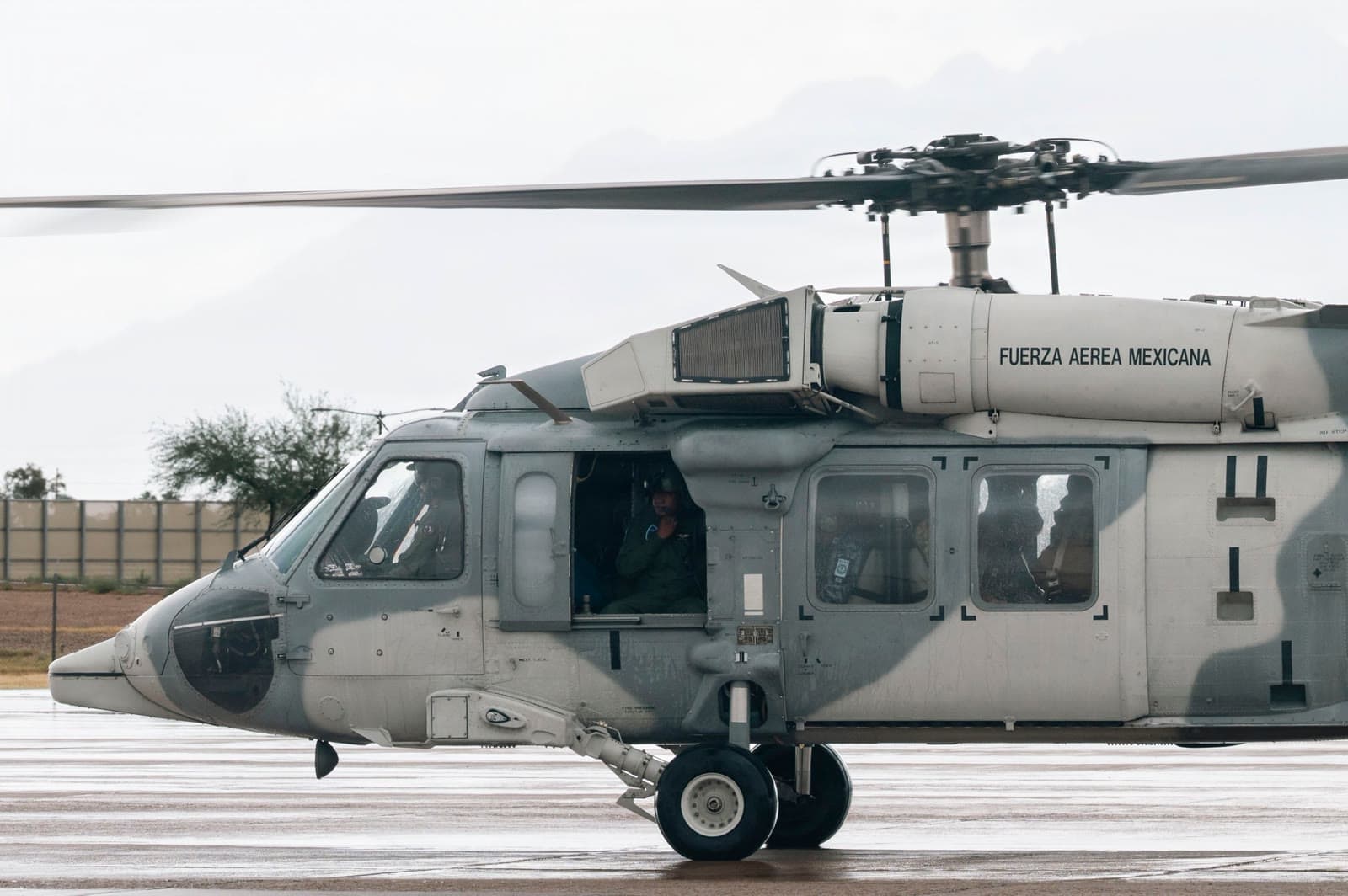
A Mexican Air Force UH-60 Black Hawk during exercise AMALGAM EAGLE 2026 at Davis-Monthan Air Force Base, Arizona. U.S. Air Force photo via DVIDS.
The two militaries already train together. In late September, Mexican Air Force Black Hawks took part in exercise AMALGAM EAGLE 2026 at Davis-Monthan Air Force Base in Arizona, an air defence and search-and-rescue exercise that brings together NORAD, U.S. Northern Command, the Mexican Air Force and other agencies. Operating the same helicopter type makes this kind of cooperation easier, from shared procedures to common maintenance knowledge.
For Sikorsky, the approval adds to a steady flow of Black Hawk export business. The UH-60M remains one of the most widely used military helicopters in the world, and more than 5,000 aircraft of the Hawk family have been delivered to dozens of countries. Latin America has long been an important market, with several regional militaries and police forces flying the type.
The process is not finished. U.S. arms sales of this size are notified to Congress, which has a review period in which lawmakers can raise objections. In practice, sales to close partners such as Mexico rarely face serious resistance, but the final contract will depend on negotiations over price, delivery schedule and exactly which equipment Mexico chooses to buy.
Delivery would also take time. New Black Hawks are built at Sikorsky's facility in the United States, and export customers usually wait several years from contract to first delivery. Training and the arrival of support personnel are built into that schedule.
If the deal goes ahead, Mexico will gain 11 modern, well-equipped helicopters suited to the type of missions its forces fly every day. More importantly, it will deepen a fleet built around one proven American design, making it easier to train crews, keep aircraft flying and coordinate with U.S. partners.
For Washington, the sale is a practical way to support a neighbour facing a long and violent fight against organised crime. For Mexico, it is a chance to replace ageing aircraft and give its security forces the mobility they need in a country where speed often decides the outcome of an operation.
The Militrax Weekly
The week's defense news, in one email.
Deals, deliveries and new weapons from every theater, explained. Every Sunday, free, no spam.
Read Next
Turkish Military S-70 Black Hawk Crashes in Malatya, Killing Four Soldiers
Black Hawks Head South: US Clears $1.1 Billion Sale to Mexico as Argentina Signs for Four
After FCAS, France Goes It Alone: The National Fighter That Must Fly by 2040
Israel's Rafael Unveils Super Ice, a Tomahawk-Class Cruise Missile With a 1,000-Pound Warhead
US Air Force Drone Wingmen Fly in Formation and Practice Air Combat Tactics With Shield AI Hivemind