KAAN vs KF-21: How Türkiye's and South Korea's New Fighters Compare
Türkiye and South Korea are both building their own twin-engine fighters, but they have taken very different routes. KF-21 entered service in September as a 4.5-generation jet with a path to stealth, while KAAN aims to be a full fifth-generation fighter from the start. A detailed look at size, stealth, engines, sensors, cost, partners and exports.
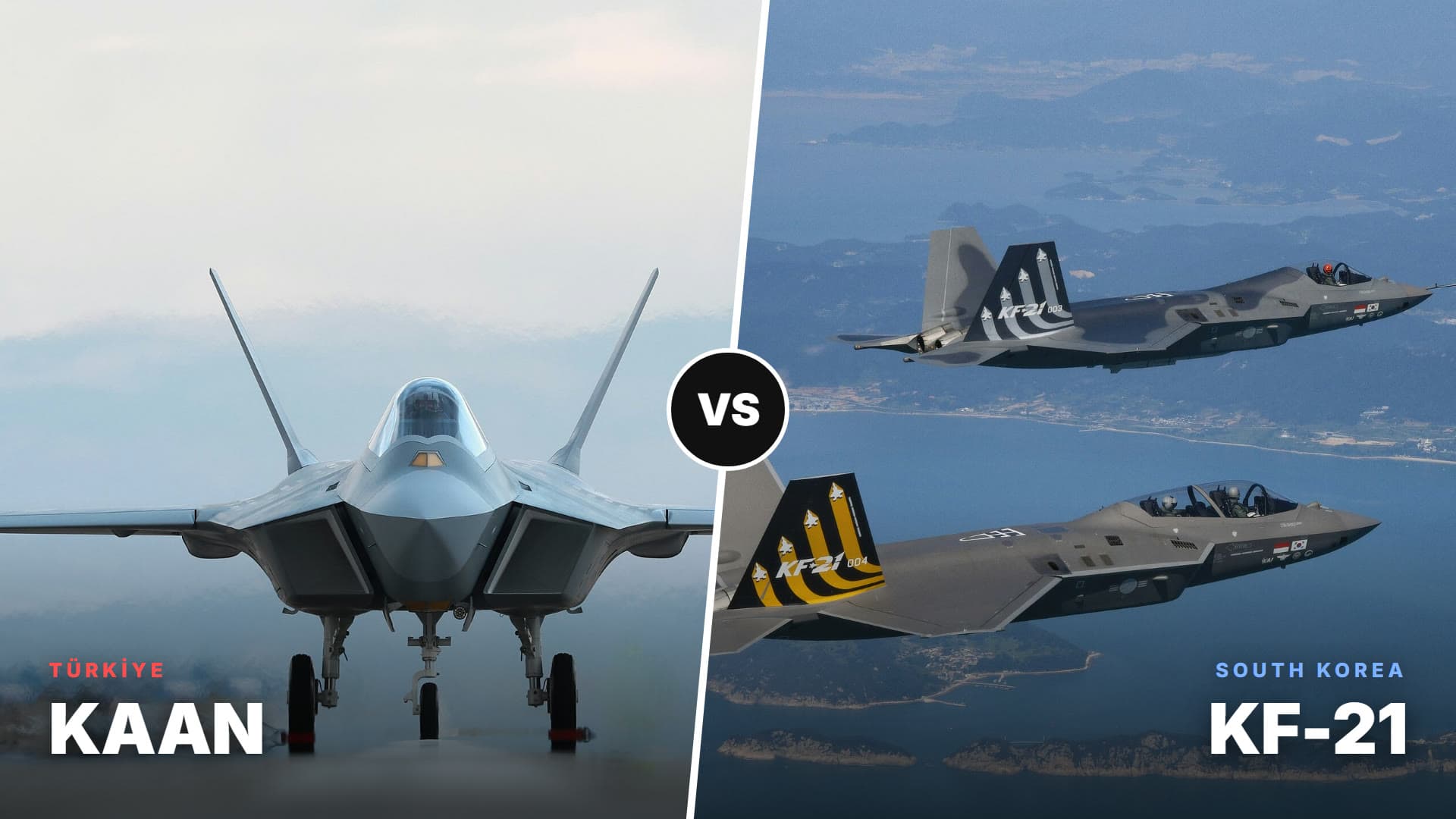
Few countries build their own fighter jets. In the past decade, two more have decided to try. Türkiye's KAAN and South Korea's KF-21 Boramae are both twin-engine combat aircraft designed by national industry, both meant to replace aging American-built fighters, and both pitched to the same group of export customers. They are often mentioned in the same breath, and Indonesia has signed up to both.
Yet the two programs have made very different bets. South Korea chose to field a capable jet quickly and add stealth features over time. Türkiye chose to design a fifth-generation stealth fighter from the outset and accept a longer road to get there. As of November 2026, that difference is visible on the ramp: the first production KF-21 is flying with a South Korean squadron, while KAAN's first production-standard prototype has just started ground runs.
This is not a question of which jet is better. They are built for different requirements, at different stages and with different budgets. What follows is a side-by-side look at what each program is, what it has achieved, and what it still has to prove.
Two answers to the same problem
Both countries faced the same basic problem: large fleets of F-16s and older jets that would need replacing in the 2030s, and a growing reluctance to depend entirely on foreign suppliers for something as central as a front-line fighter.
South Korea moved first. President Kim Dae-jung announced the KF-X program in March 2001, but it took more than a decade to settle the requirements and the budget. Indonesia joined as a partner in 2010, initially agreeing to fund 20 percent of development. Korea Aerospace Industries (KAI) received the development contract at the end of 2015. From the start, the plan was evolutionary: an airframe shaped to reduce radar signature, but carrying its first weapons partly outside the fuselage, with full stealth features left for later versions.
Türkiye's program, first known as TF-X, was approved by the country's Defense Industry Executive Committee in December 2010. Turkish Aerospace (TUSAŞ) received the design and development contract in 2016, and BAE Systems signed a deal in January 2017 worth about 100 million pounds to provide engineering support. The goal was more ambitious from day one: a stealth fighter with internal weapons bays, comparable in concept to the F-22 and F-35 rather than to a modernized fourth-generation jet.
Those choices explain most of the differences that follow. KF-21 is described by its makers as a 4.5-generation fighter in its first versions, with a route to a fifth-generation variant later. KAAN is described by Turkish Aerospace as a fifth-generation fighter from the first production block.
Where the programs stand in November 2026

Key milestones of the KAAN and KF-21 programs. Dates after November 2026 are official plans and targets. Militrax graphic.
KF-21 is the more mature of the two. The first prototype was rolled out in April 2021 and made its first flight on July 19, 2022. Six prototypes, including two-seaters, flew a test campaign that included supersonic flight and weapons separation trials. Serial production began in 2024, South Korea's Defense Acquisition Program Administration granted the jet its final combat suitability certification in May 2026, and system development was formally completed in July.
On September 22, 2026, the first production KF-21 flew from KAI's plant in Sacheon to Yecheon Air Base and was handed over to the 156th Fighter Squadron. The air force has 40 Block I aircraft on order, with 20 due by 2027 and the rest by 2028. A further 80 Block II jets, with air-to-ground capability, are planned by 2032, which would bring the fleet to 120.
KAAN is earlier in its development, but moving. Turkish Aerospace rolled out the first aircraft in March 2023, and it flew for the first time on February 21, 2024. That aircraft, known as P0, is a test platform rather than a production-standard jet. The more important milestone came at the end of July 2026, when the P1 prototype, the first built to closely represent the intended production configuration, began powered taxi tests in Ankara. At the Farnborough Airshow in July, Turkish Aerospace chief executive Mehmet Demiroğlu said both P1 and P2 would fly before the end of the year.
Turkish Aerospace has said it aims to deliver the first Block 10 aircraft to the Turkish Air Force toward the end of the decade. Whether that schedule holds will depend on how quickly the new prototypes move through flight testing, which typically takes several years for a new fighter.
In short, KF-21 is roughly three to four years ahead in the development cycle. It is already doing what KAAN still has to do: fly a full test campaign, certify weapons and enter production.
Size and design philosophy

KAAN and KF-21 compared using manufacturer figures for their current configurations. Militrax graphic.
The most striking difference is size. According to Turkish Aerospace's published specification, KAAN is 20.3 meters long with a wingspan of 13.4 meters and a wing area of 71.6 square meters. Its maximum takeoff weight is listed at 34,750 kilograms. That puts KAAN closer in length to the American F-22 than to the F-16 it is meant to replace.
KF-21 is a smaller aircraft. KAI lists it at 16.9 meters long, with an 11.2-meter wingspan, 46.5 square meters of wing area and a maximum takeoff weight of 25,600 kilograms. In size it sits between an F-16 and an F/A-18E/F Super Hornet.
The size gap is not an accident. A stealth fighter has to carry its fuel, weapons and sensors inside the airframe, because anything hung under the wings reflects radar energy. That demands a bigger, deeper fuselage. KAAN's large wing also lowers wing loading, which generally helps high-altitude performance and maneuvering. The cost is weight, drag and, usually, price.
KF-21's smaller airframe reflects its role as a more affordable multirole fighter that can be bought in larger numbers. It can carry up to 7,700 kilograms of weapons and stores on ten external hardpoints, according to KAI, and holds about 6,000 kilograms of fuel internally. Turkish Aerospace has not published KAAN's internal fuel or combat radius.
On paper, top speed is almost identical. Turkish Aerospace lists KAAN at Mach 1.8, and KAI lists KF-21 at Mach 1.81, or about 2,200 kilometers per hour. Both are rated for nine g.
Stealth: built in versus built up
This is where the two programs differ most in philosophy.
KAAN has been designed around internal weapons bays from the beginning, much like the F-22 and F-35. Turkish weapons are being shaped to fit them: the SOM-J cruise missile, for example, was designed to be carried inside the bays of both KAAN and the F-35. The airframe uses the features associated with low-observable design, including canted twin tails, aligned edges and serpentine inlets meant to hide the engine faces from radar.
KF-21 also has a stealth-shaped airframe, with angled surfaces, canted tails and aligned edges, but the Block I and Block II versions do not have internal weapons bays. Instead, four long-range air-to-air missiles sit partly recessed into the underside of the fuselage, which reduces their radar signature compared with a conventional pylon but does not hide them. KAI and South Korean officials have described a later, fuller stealth version with internal bays, often referred to as Block III or KF-21EX, but it has not yet been funded as a production program.
Neither country has published radar cross-section figures, and any claim about how stealthy either aircraft is should be treated with caution. What can be said is that KAAN's design is aimed at a higher stealth standard, while KF-21 trades some of that for lower cost, earlier service entry and a larger external payload.
Engines: the American dependency
For all their emphasis on independence, both fighters fly on American engines today.
KAAN uses two General Electric F110-GE-129 engines, the same family that powers late-model F-16s, each producing 131 kilonewtons of thrust with afterburner, according to Turkish Aerospace. The engines are assembled in Türkiye by TEI but remain subject to US export controls. That has been a real concern in Ankara, given years of friction with Washington over Türkiye's purchase of the Russian S-400 system. In 2026, the US approved the supply of F110 engines for the first production block of KAAN.
Türkiye's long-term answer is the TF35000, a domestic engine being developed by TEI. Prototype engines have been built, and qualification testing was scheduled to begin in 2026. Turkish officials have set a target of integrating the engine into KAAN around 2032. Building a fighter engine is widely seen as the hardest part of any combat aircraft program, and only a handful of countries have done it.
KF-21 uses two General Electric F414-GE-400K engines, the same family as the Super Hornet, each producing 97.9 kilonewtons with afterburner. Hanwha Aerospace builds them in South Korea under license. KAAN's engines are therefore about a third more powerful each, which matches its larger size and weight. South Korea has also begun funding work on its own fighter engine for the 2030s, but has not tied it to a firm KF-21 timeline.
Sensors and weapons

The KAAN prototype during taxi trials at Turkish Aerospace in Ankara, March 2023. Photo: Dimir / Wikimedia Commons, CC BY-SA 4.0.
Both programs were pushed toward domestic sensors, partly by necessity. In 2015, the United States declined to transfer four key technologies for KF-21: the active electronically scanned array (AESA) radar, the infrared search and track system, the electro-optical targeting pod and the radio-frequency jammer. South Korea responded by developing all four at home. Hanwha Systems built the AESA radar, Hanwha also produced the infrared search and track system with a sensor head from Italy's Leonardo, and LIG Nex1 developed the electronic warfare suite.
For weapons, the same pressure applied. When US approval for AIM-120 and AIM-9X missiles was delayed, South Korea integrated Europe's Meteor long-range air-to-air missile and Germany's IRIS-T short-range missile instead. Block II aircraft are expected to add air-to-ground weapons, including a Korean long-range strike missile.
KAAN's sensors are being developed mainly by Turkish industry, led by ASELSAN, including an AESA radar, an infrared search and track system, an electro-optical targeting system and an electronic warfare suite. Its planned weapons are almost entirely Turkish: the Gökdoğan beyond-visual-range and Bozdoğan short-range air-to-air missiles developed by TÜBİTAK SAGE, SOM cruise missiles, and a range of guided bombs and stand-off weapons. Fitting these weapons inside the bays and certifying them in flight will be a major part of KAAN's test program.
The approaches mirror each other. South Korea used European weapons to get into service faster, while Türkiye is betting on its own missile industry, which is already exporting, to arm KAAN from the start.
Cost, partners and politics

KF-21 prototypes 003 and 004 during flight testing, October 2023. Photo: Defense Acquisition Program Administration, KOGL Type 1.
Indonesia ties the two programs together. It joined KF-21 in 2010 as a 20 percent development partner but fell far behind on its payments. In June 2025, the two governments signed a revised agreement that cut Indonesia's contribution from about 1.6 trillion won to roughly 600 billion won. Days earlier, Indonesia had signed a government-to-government agreement with Türkiye for KAAN, and on July 26, 2025, at the IDEF exhibition in Istanbul, it signed a contract for 48 KAAN fighters. Reports since then suggest Jakarta is still discussing a smaller KF-21 purchase, but no firm order had been confirmed by November 2026.
South Korea funds most KF-21 development itself and has kept the program close to schedule, which is unusual for a new fighter. Türkiye funds KAAN mainly through its national budget, with BAE Systems providing engineering support. Azerbaijan signed an agreement in 2023 to take part in the program.
Neither government has published a full program cost or a reliable unit price that can be compared on equal terms. Development costs, production rates, engine choices and what is included in each figure vary too much to draw a clean comparison.
Export competition
Both countries see exports as essential. Fighter programs only become affordable when production lines run at high rates for many years, and neither the Turkish nor the South Korean air force alone can provide that volume.
KAAN has its first export contract in Indonesia, and Turkish officials have discussed the jet with several countries in the Middle East and South Asia. KF-21 has drawn interest from the Philippines, Poland, the United Arab Emirates and others, and Korea's success with the FA-50 light fighter in Poland, the Philippines and Malaysia gives KAI an established customer network.
They are not necessarily competing for the same buyers. KF-21 is likely to appeal to air forces that want a modern, capable fighter soon and at a moderate price. KAAN is aimed at customers who want a full stealth aircraft without buying American or Chinese, and who can wait for it.
What each program still has to prove
For KF-21, the next tests are operational. The air force has to build up the first squadron, train pilots and maintainers and prove that the jet is reliable in daily service. Block II has to deliver its air-to-ground capability on time, and South Korea will eventually have to decide whether to fund a true stealth version with internal weapons bays.
For KAAN, the biggest test is the one now starting: a full flight test campaign with production-standard prototypes, followed by weapons integration, production and delivery. Securing a steady supply of F110 engines in the meantime, and then bringing the TF35000 into service, will shape the program well into the 2030s.
Each program has already achieved something few countries manage. South Korea has put a domestically designed supersonic fighter into service. Türkiye has flown a twin-engine fighter designed around stealth. The next five years will show whether KF-21 can grow into a stealth fighter and whether KAAN can reach squadrons on schedule.
Sources
- TUSAŞ: KAAN technical specification
- Korea Aerospace Industries: KF-21
- FlightGlobal: TAI on KAAN schedule and F110 deliveries
- Interesting Engineering: KAAN P1 taxi tests
- FlightGlobal: first production KF-21 delivered
- The Aviationist: first production KF-21
- Breaking Defense: revised KF-21 agreement with Indonesia
- AeroTime: Indonesia orders 48 KAAN
- FlightGlobal: Hanwha to build F414 engines for KF-21
- GE Aerospace: first F414 delivered for KF-X
The Militrax Weekly
The week's defense news, in one email.
Deals, deliveries and new weapons from every theater, explained. Every Sunday, free, no spam.
Read Next
Turkish Military S-70 Black Hawk Crashes in Malatya, Killing Four Soldiers
Black Hawks Head South: US Clears $1.1 Billion Sale to Mexico as Argentina Signs for Four
After FCAS, France Goes It Alone: The National Fighter That Must Fly by 2040
Israel's Rafael Unveils Super Ice, a Tomahawk-Class Cruise Missile With a 1,000-Pound Warhead
US Air Force Drone Wingmen Fly in Formation and Practice Air Combat Tactics With Shield AI Hivemind