Navy2 min read
Damen Unveils Design for the Dutch-British Amphibious Transport Ship Programme
The design of the Royal Netherlands Navy's new Amphibious Transport Ship was shown at NEDS 2026. Britain will operate four of the same type in a joint eight-ship programme worth £2.4 billion for the UK.
By Michael Korten ·
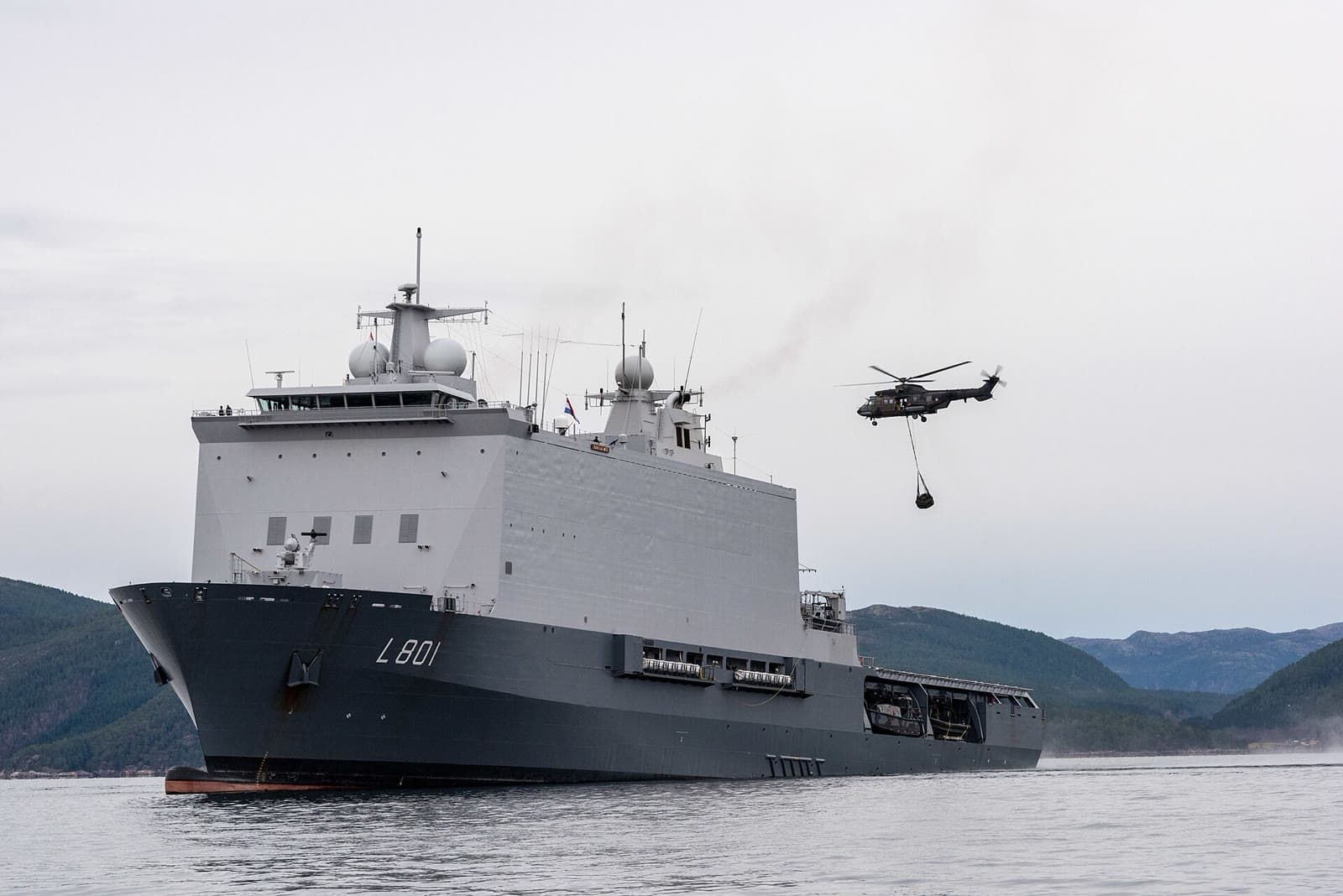
The ship that will carry Dutch and British marines for decades now has a public face. Damen Naval unveiled the design of the Royal Netherlands Navy's new Amphibious Transport Ship at the NEDS 2026 naval exhibition, and signed an agreement with electrical integrator Alewijnse to work more closely on the programme.
The new ships will replace the Dutch landing platform docks HNLMS Rotterdam and HNLMS Johan de Witt. In July, Britain agreed to operate four of the same type in a joint eight-ship programme.
Eight ships, two navies
Prime Ministers Keir Starmer and Rob Jetten signed the UK-Netherlands agreement at the NATO summit in Ankara on July 7. The British government said its ships, worth £2.4 billion in total, would be based on the Dutch design and built in UK shipyards alongside Dutch industry. Each will be 160 metres long, displace 15,000 tonnes and carry troops, vehicles, equipment and drones, with a flight deck designed for long-range drones and autonomous systems.
For Britain, they replace the amphibious capability lost when HMS Albion and HMS Bulwark were retired. Bulwark is now being prepared at Devonport for transfer to Brazil. No British yard has been chosen; Lord Coaker, Minister of State at the Ministry of Defence, listed the programme among future shipbuilding opportunities in a parliamentary answer this week, and Balaena Structures has pitched its yards.
Alewijnse will integrate and install all the electrical systems on the ships. "Strengthening our cooperation is an important next step that helps ensure the continuity of naval shipbuilding programmes," said Roland Briene, managing director of Damen Naval.
Why it matters
Britain's marines have spent several years without dedicated assault ships, relying on auxiliaries and allied decks. A joint design with the Netherlands, whose marines already train closely with the Royal Marines, spreads the design cost and makes the two forces interchangeable. The early debate among readers of British defence media is about size: at 15,000 tonnes the ships are smaller than a Mistral, and questions remain over how many heavy helicopters like the Chinook they can operate. Four capable hulls, delivered on time, would still be a big step up from today.