Navy2 min read
F-35C Completes First Launch and Recovery Trials on a Ford-Class Carrier, USS John F. Kennedy
Two US Navy F-35Cs made 122 catapult launches and 122 arrested landings aboard the future USS John F. Kennedy, the first time the jet has operated from a Ford-class carrier. Lockheed Martin says the Navy has now cleared the F-35C for its entire carrier fleet.
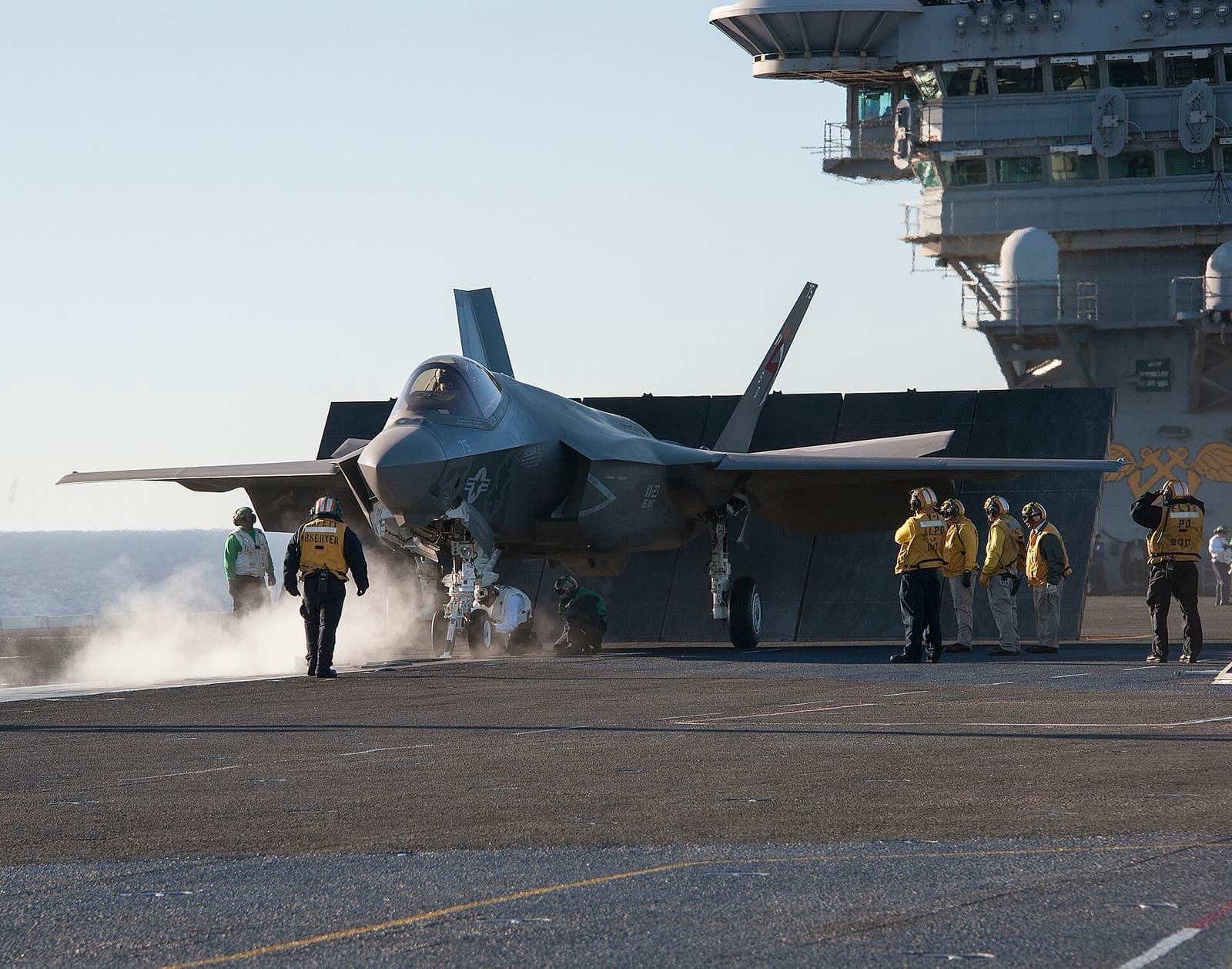
The US Navy's stealth fighter has finally flown from its newest class of aircraft carrier. Two F-35C Lightning IIs completed the jet's first round of launch and recovery testing aboard the future USS John F. Kennedy, the second Gerald R. Ford-class carrier, Lockheed Martin said on Thursday.
Over 11 days of testing that began on October 13, the Navy's 251st birthday, the two jets flew 34 sorties and logged 122 catapult launches and 122 arrested landings. The aircraft belong to Air Test and Evaluation Squadron 23, the "Salty Dogs," from Naval Air Station Patuxent River in Maryland. The flights were part of Kennedy's aircraft compatibility testing, which checks how a ship's launch and recovery equipment works with each type of aircraft.
"This is a critical event for the F-35C, Kennedy, and the United States Navy," said Sean Jackson, vice president of Lockheed Martin's F-35 Development Program. He said the Navy has now cleared the F-35C for operations across its entire carrier fleet.
New catapults, new deck
The Ford class is a different ship to operate from. Nimitz-class carriers use steam catapults and hydraulic arresting gear; Fords use the Electromagnetic Aircraft Launch System (EMALS) and Advanced Arresting Gear (AAG). Lockheed says EMALS gives smoother, more precisely controlled launches, while AAG can handle a wider range of recovery conditions. The Ford's smaller island sits about 140 feet farther aft than on a Nimitz, which, with the redesigned flight deck, changes airflow, exhaust patterns and deck operations.
The sea trials followed shore-based testing from January 2024 to May 2025 that validated the jet's structural models and the software behind EMALS and AAG. The data will feed the launch and recovery bulletins crews use on Ford-class decks.
Cleared, but not yet deploying
A Lockheed official told Defense News the ships are cleared to launch and recover F-35s once those bulletins are published, but "will not be ready to deploy until fully outfitted with supporting equipment." The Navy has final clearance.
Kennedy was modified during construction to deploy with the F-35C after Congress required it in 2020. The Navy took preliminary acceptance of the ship on September 29 and plans formal delivery in spring 2027. The lead ship, USS Gerald R. Ford, has never deployed with the jet and is due to be retrofitted.
Why it matters
The F-35C first landed on a carrier in 2014, aboard Nimitz. Twelve years later, the Navy's most expensive carriers are only now catching up with its newest fighter. Clearing the F-35C on the Ford class matters because the Fords will make up a growing share of the fleet as the Nimitz carriers retire, and a carrier air wing that cannot bring its stealth fighters is a much weaker one against China's air defences in the Pacific.